DeepSeek-V4-Flash-Vision-Exp Explained: DeepSeek’s New Multimodal Model
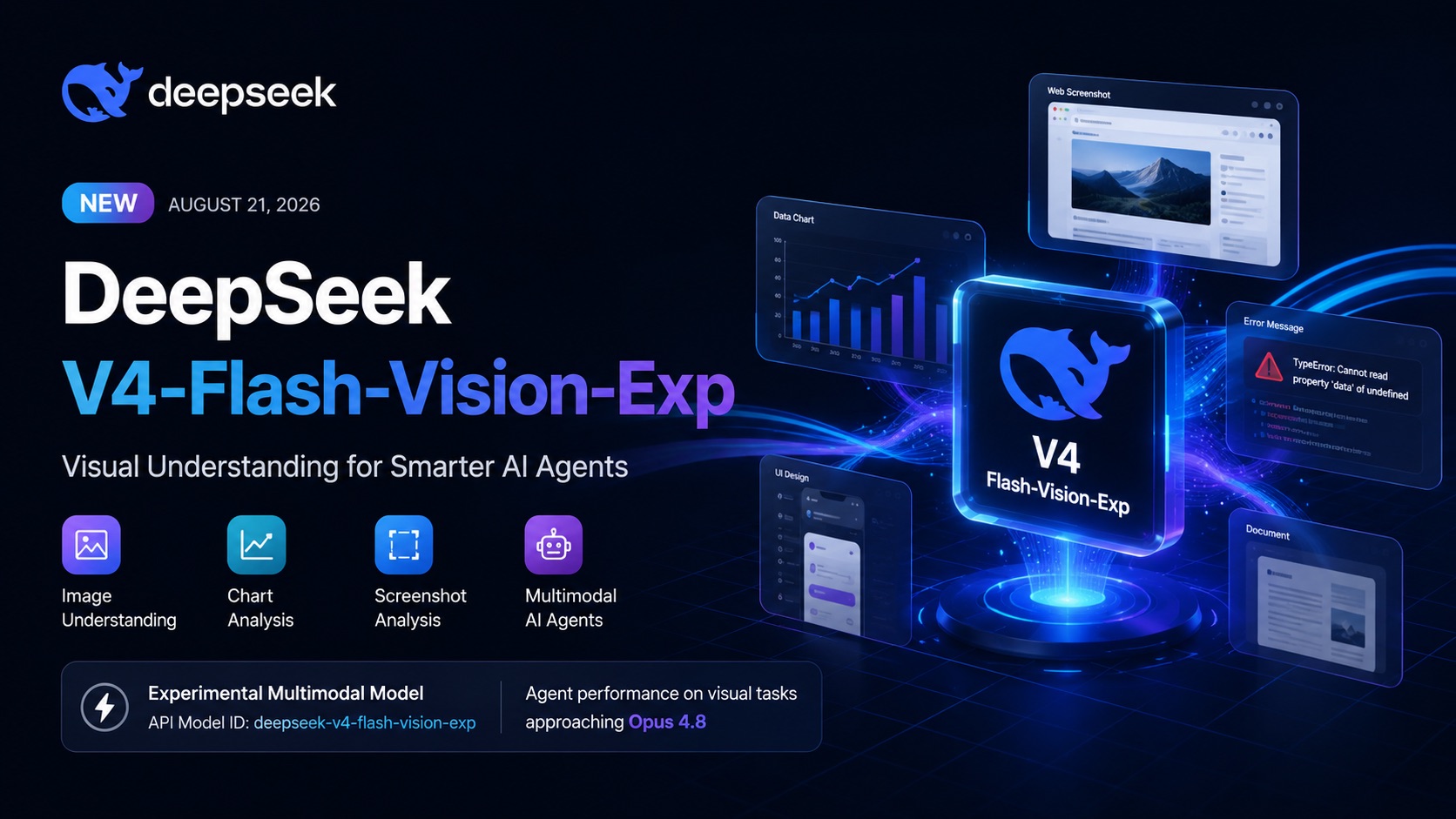
Learn what DeepSeek-V4-Flash-Vision-Exp is, how its new vision capability differs from DeepSeek-V4-Flash, what the official benchmarks show, and why visual understanding matters for multimodal AI agents. This guide also covers screenshot and chart analysis, API access, current limitations, and the model’s comparison with Opus 4.8.
DeepSeek has expanded its V4 family with a capability that was previously missing from V4 Flash: native visual understanding. On August 21, 2026, the company introduced DeepSeek-V4-Flash-Vision-Exp, an experimental multimodal model available through the DeepSeek API.
Instead of working only with text, code, and tool outputs, the new model can also process visual information. This allows DeepSeek to interpret screenshots, charts, interfaces, images, and other visual inputs while retaining the reasoning and agent capabilities of DeepSeek-V4-Flash.
The release is especially interesting for AI agents. A model that can reason about code is useful, but an agent that can also inspect what is actually displayed on a screen has access to a much richer feedback loop.
So what exactly is DeepSeek-V4-Flash-Vision-Exp, how is it different from V4 Flash, and how much does the new vision capability change what DeepSeek can do?
What Is DeepSeek-V4-Flash-Vision-Exp?
DeepSeek-V4-Flash-Vision-Exp is an experimental multimodal vision understanding model in the DeepSeek V4 family.
The important word is understanding. This is not an AI image generator designed to create images from prompts. Instead, the model accepts visual information as input, analyzes what it sees, and combines that information with its existing language, reasoning, coding, and agent abilities.
DeepSeek officially made the model available on its API platform with the model identifier:
deepseek-v4-flash-vision-exp
According to DeepSeek, its pure-text abilities—including reasoning, world knowledge, and agent performance—remain on par with the official DeepSeek-V4-Flash. The major addition is the ability to understand visual information.
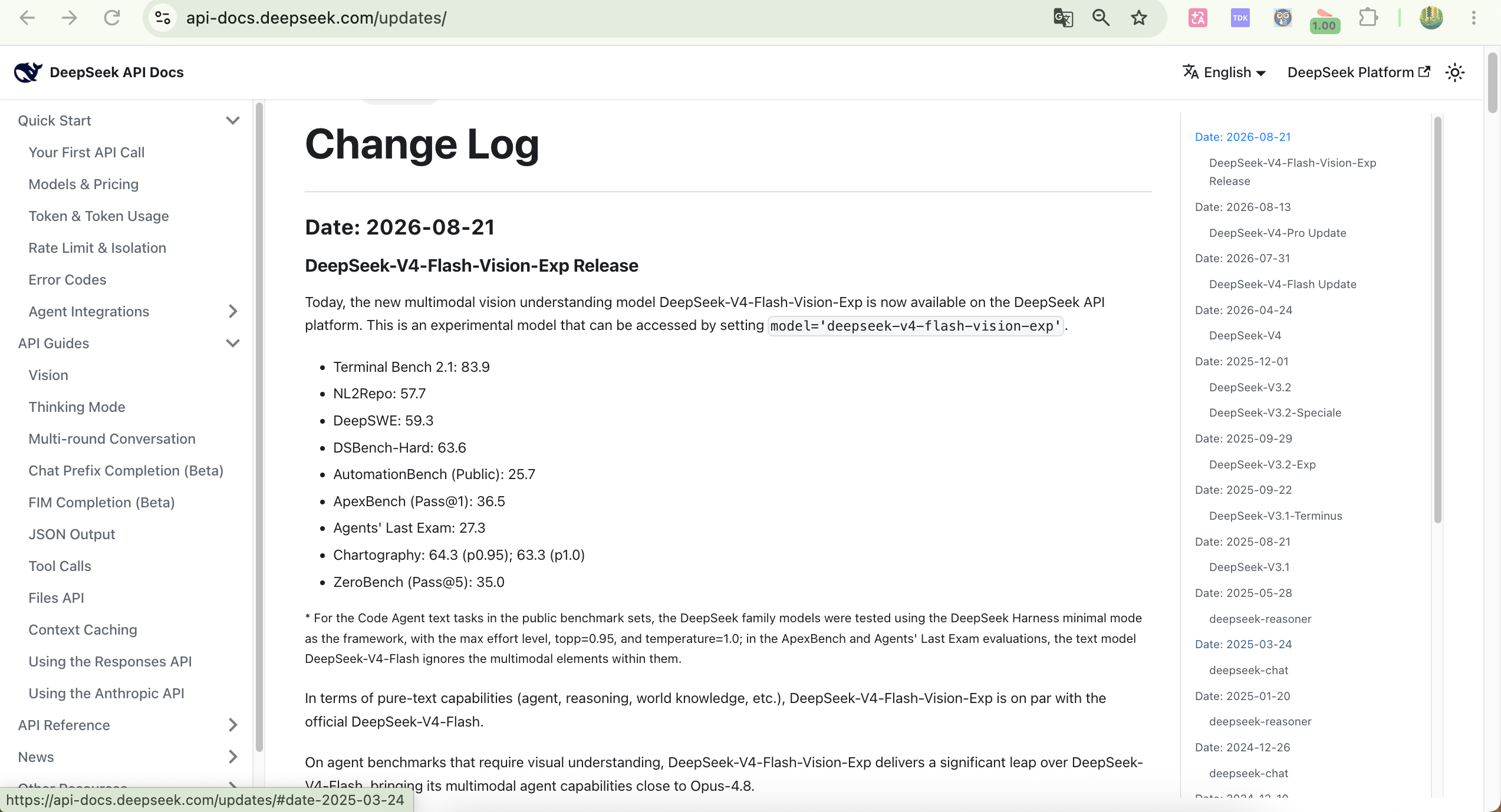
DeepSeek officially announced the experimental DeepSeek-V4-Flash-Vision-Exp model on August 21, 2026.
Source: DeepSeek API Docs — Change Log.
In practice, adding vision means the model can work with information that is difficult to represent completely through text alone. A screenshot of a website, for example, contains layout, spacing, visual hierarchy, colors, interface states, and text at the same time. A vision-enabled model can inspect those elements directly rather than depending entirely on a user's description.
What Vision Adds to DeepSeek V4 Flash
DeepSeek-V4-Flash already focused heavily on reasoning, coding, tool use, and agent workflows. The new Vision Exp model does not replace those capabilities. Instead, it adds another way for the model to perceive the environment.
Reading Screenshots and Interfaces
One of the most obvious applications is screenshot understanding.
A developer could provide a screenshot of a webpage or interface and ask the model to identify visible problems, interpret an error message, compare the rendered page with a reference, or explain what is happening on screen.
For example, vision could help with questions such as:
- Why does this interface appear misaligned?
- Which part of the page is overflowing?
- What does the error dialog say?
- Does this implementation visually match the reference?
- What elements are visible in the current application state?
This is particularly useful for coding agents because source code alone does not always reveal how the final interface actually looks.
Understanding Charts and Visual Information
Vision also extends DeepSeek beyond ordinary photographs.
Charts, dashboards, diagrams, screenshots containing text, and other visual representations can become part of the model's reasoning context. Rather than manually converting every visual element into a written description, users can give the model the visual input and ask it to interpret what it contains.
That can be useful in workflows involving reports, analytics dashboards, technical diagrams, UI reviews, and visual documents.
Closing the Agent Feedback Loop
The more important change appears when vision is combined with agents.
A text-only coding agent may be able to edit a webpage, run commands, and inspect logs. But if the final problem is visual—such as an incorrectly positioned button—it may not be able to directly observe the result.
Vision makes a workflow like this possible:
Action → visual result → visual analysis → next action
That changes vision from a simple image-question feature into a form of perception that an agent can potentially use during longer tasks.
DeepSeek-V4-Flash-Vision-Exp vs DeepSeek-V4-Flash
The relationship between the two models is relatively straightforward. Vision Exp should not be interpreted as a completely new replacement for DeepSeek-V4-Flash.
Its main distinction is multimodal input.
| Capability | DeepSeek-V4-Flash | DeepSeek-V4-Flash-Vision-Exp |
|---|---|---|
| Text understanding | Yes | Yes |
| Reasoning | Yes | Yes |
| Coding | Yes | Yes |
| Agent tasks | Yes | Yes |
| Native image understanding | No | Yes |
| Screenshot analysis | No | Yes |
| Chart and visual analysis | No | Yes |
| Multimodal agent tasks | Limited by text-only input | Yes |
| Current status | Official V4 Flash | Experimental |
DeepSeek specifically states that DeepSeek-V4-Flash-Vision-Exp remains on par with the official V4 Flash in pure-text capabilities.
So switching to Vision Exp does not simply mean getting a stronger text model. The more meaningful difference is that the model can now reason from another type of input.
How Strong Is DeepSeek-V4-Flash-Vision-Exp?
DeepSeek published a set of benchmark results with the announcement.
Some of the reported scores include:
| Benchmark | DeepSeek-V4-Flash-Vision-Exp | DeepSeek-V4-Flash |
|---|---|---|
| Terminal Bench 2.1 | 83.9 | 82.7 |
| NL2Repo | 57.7 | 54.2 |
| DeepSWE | 59.3 | 54.4 |
| DSBench-Hard | 63.6 | 59.6 |
| AutomationBench (Public) | 25.7 | 25.1 |
| ApexBench Pass@1 | 36.5 | 26.2 |
| Agents' Last Exam | 27.3 | 25.2 |
DeepSeek also reports 64.3 at p0.95 on Chartography and 35.0 Pass@5 on ZeroBench for Vision Exp.
The numbers show improvements across several agent-oriented benchmarks, although the size of the improvement varies considerably from test to test. The largest differences become particularly relevant when visual information is part of the evaluation.
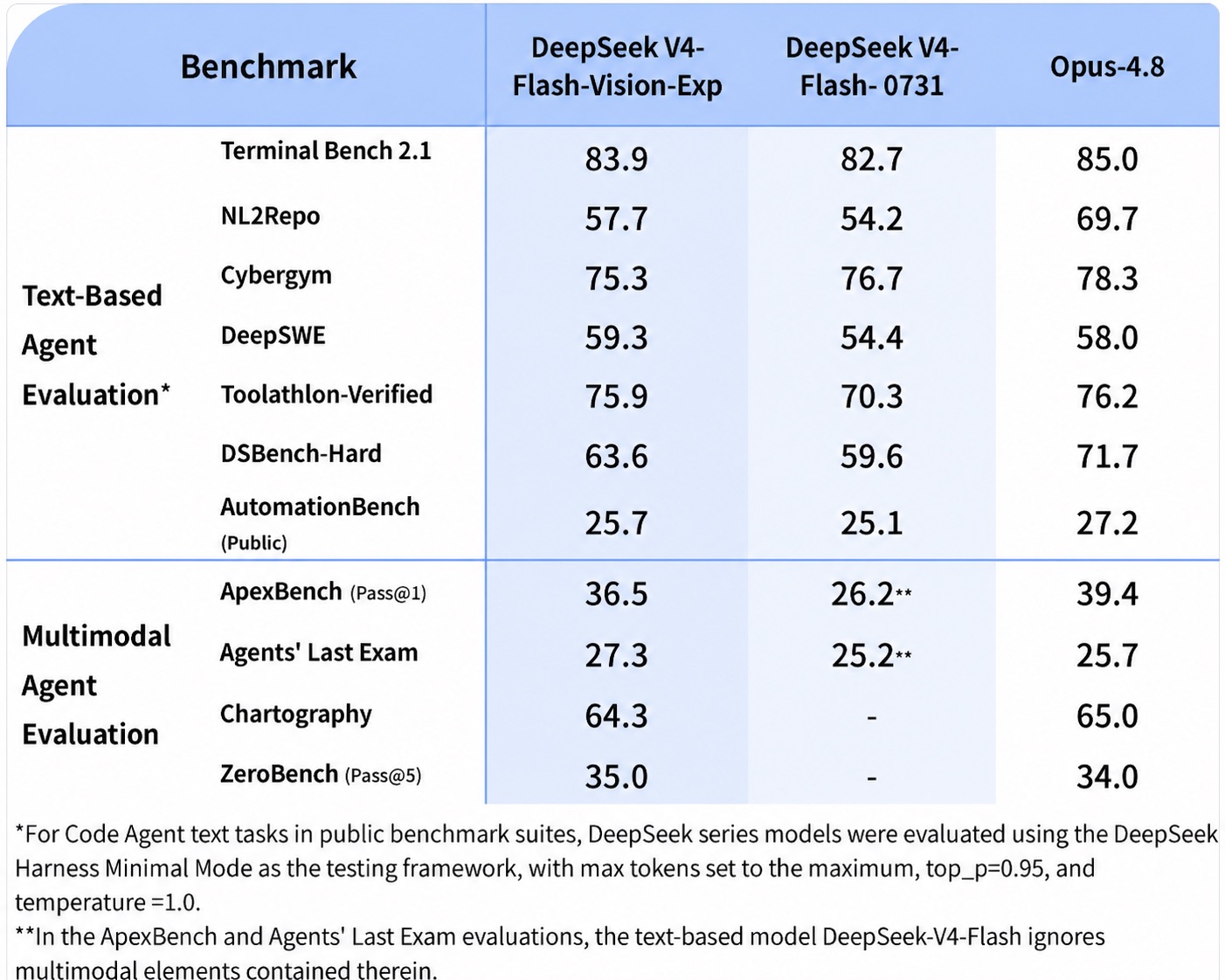
Official benchmark results show improvements for DeepSeek-V4-Flash-Vision-Exp across several agent evaluations.
Source: DeepSeek API Docs — DeepSeek-V4-Flash-Vision-Exp Release.
Does “Close to Opus 4.8” Mean It Matches Opus 4.8?
This part of the announcement needs some context.
DeepSeek says that on agent benchmarks requiring visual understanding, Vision Exp makes a significant leap over V4 Flash and brings its multimodal agent capabilities close to Opus 4.8.
That should not be interpreted as a claim that DeepSeek-V4-Flash-Vision-Exp is universally equal to Opus 4.8.
The statement refers specifically to multimodal agent performance in the benchmarks DeepSeek discussed. It does not establish that the models perform identically across every reasoning, coding, knowledge, visual understanding, or general-purpose task.
A more accurate takeaway is that adding vision substantially improves V4 Flash in agent tasks where visual perception matters.
Why Vision Matters More for Agents Than Simple Image Chat
At first glance, the release could be summarized as “DeepSeek can now look at images.”
That is true, but it undersells why the change matters.
Modern AI agents increasingly operate outside a plain text conversation. They may interact with browsers, terminals, web applications, dashboards, documents, development environments, and graphical interfaces.
Many of those environments expose important information visually.
Consider a web development agent. It might:
- Write or modify frontend code.
- Run the application.
- Open the page in a browser.
- Inspect the rendered result.
- Identify a visual problem.
- Change the code again.
Without vision, step four often requires another system to translate what is visible into text. With native visual understanding, the model has a more direct path to interpreting the result.
This distinction was already visible in the DeepSeek Harness community before Vision Exp appeared.
Just days before the official model release, developers were building plugins specifically to give text-only DeepSeek-V4-Flash access to images. One community plugin, dsh-vision, sent images to a separate vision model and returned a text description that V4 Flash could understand.
Another discussion described how DeepSeek Harness rejected image attachments when the active DeepSeek model declared only text input. Users proposed separate “vision helper” models as a workaround.
What Could DeepSeek-V4-Flash-Vision-Exp Be Used For?
Because vision is combined with the existing strengths of V4 Flash, the model could be relevant to several kinds of workflows.
UI and Frontend Development
A coding agent could inspect rendered interfaces instead of reasoning only from HTML, CSS, JavaScript, or component code.
Potential tasks include checking layouts, identifying obvious visual defects, reading interface states, and comparing screenshots with references.
Browser and Computer Agents
Browser agents frequently encounter information that is easier to understand visually than through page source alone.
Visual perception could help an agent interpret what is currently displayed, identify interface elements, understand graphical states, or decide what needs attention before taking another action.
Charts and Reports
Visual understanding also creates opportunities for analyzing charts, dashboards, diagrams, and image-based reports. These tasks combine perception with the reasoning abilities that DeepSeek already provides.
Debugging From Screenshots
Users frequently share screenshots rather than complete logs. Error windows, browser messages, terminal captures, and application states can contain enough information to diagnose a problem.
Vision allows that evidence to enter the same reasoning process as the user's written explanation.
How to Access DeepSeek-V4-Flash-Vision-Exp
The model is currently available through the DeepSeek API.
Developers can select it using:
model='deepseek-v4-flash-vision-exp'
DeepSeek provides a dedicated Vision guide for sending visual inputs to the model. This is important because image-containing requests need to use a model that actually supports visual input; the ordinary DeepSeek-V4-Flash remains the text-focused model.
For developers who only need ordinary reasoning or coding without images, V4 Flash may still be sufficient. Vision Exp becomes more relevant when screenshots, charts, interfaces, or other visual information are an essential part of the task.
The Exp suffix also matters. DeepSeek explicitly labels this model as experimental, so its current interface, capabilities, performance, or positioning should not automatically be treated as the final form of vision support in the V4 family.
Current Limitations and Questions
DeepSeek-V4-Flash-Vision-Exp is new enough that several aspects will need more real-world testing.
First, benchmark performance does not guarantee identical performance across production tasks. Screenshot reasoning, OCR-heavy images, dense interfaces, charts, diagrams, and visual agent workflows can place very different demands on a multimodal model.
Second, Vision Exp is a visual understanding model, not an image-generation model. It can analyze visual inputs, but it is not positioned as a model for creating new images from text prompts.
Third, it remains experimental. That means it makes sense to avoid treating the current release as the definitive multimodal version of DeepSeek V4.
The most interesting questions now are less about whether DeepSeek can recognize an image and more about how reliably that visual capability works inside long-running agent workflows.
What DeepSeek-V4-Flash-Vision-Exp Signals for DeepSeek V4
DeepSeek-V4-Flash-Vision-Exp matters because it fills a clear gap in an increasingly agent-focused model family.
V4 Flash already had strong coding, reasoning, tool-use, and agent capabilities. But many real-world environments cannot be understood entirely through text. Webpages have layouts, dashboards contain charts, applications expose visual states, and software can produce errors that users capture as screenshots.
Vision gives the model access to that information directly.
For ordinary users, the immediate benefit is straightforward: DeepSeek can understand visual input.
For AI agents, the change could be more important. It introduces the possibility of combining reasoning, actions, and visual observation inside the same workflow rather than depending on a separate vision model to describe what the agent should see.
DeepSeek-V4-Flash-Vision-Exp is still experimental, so it is too early to treat it as the final multimodal form of DeepSeek V4. But its direction is clear.
DeepSeek is moving from agents that primarily reason and act toward agents that can also see what happened next.