Luna-lisa-alpha: What We Know About OpenAI's Next Major AI Model
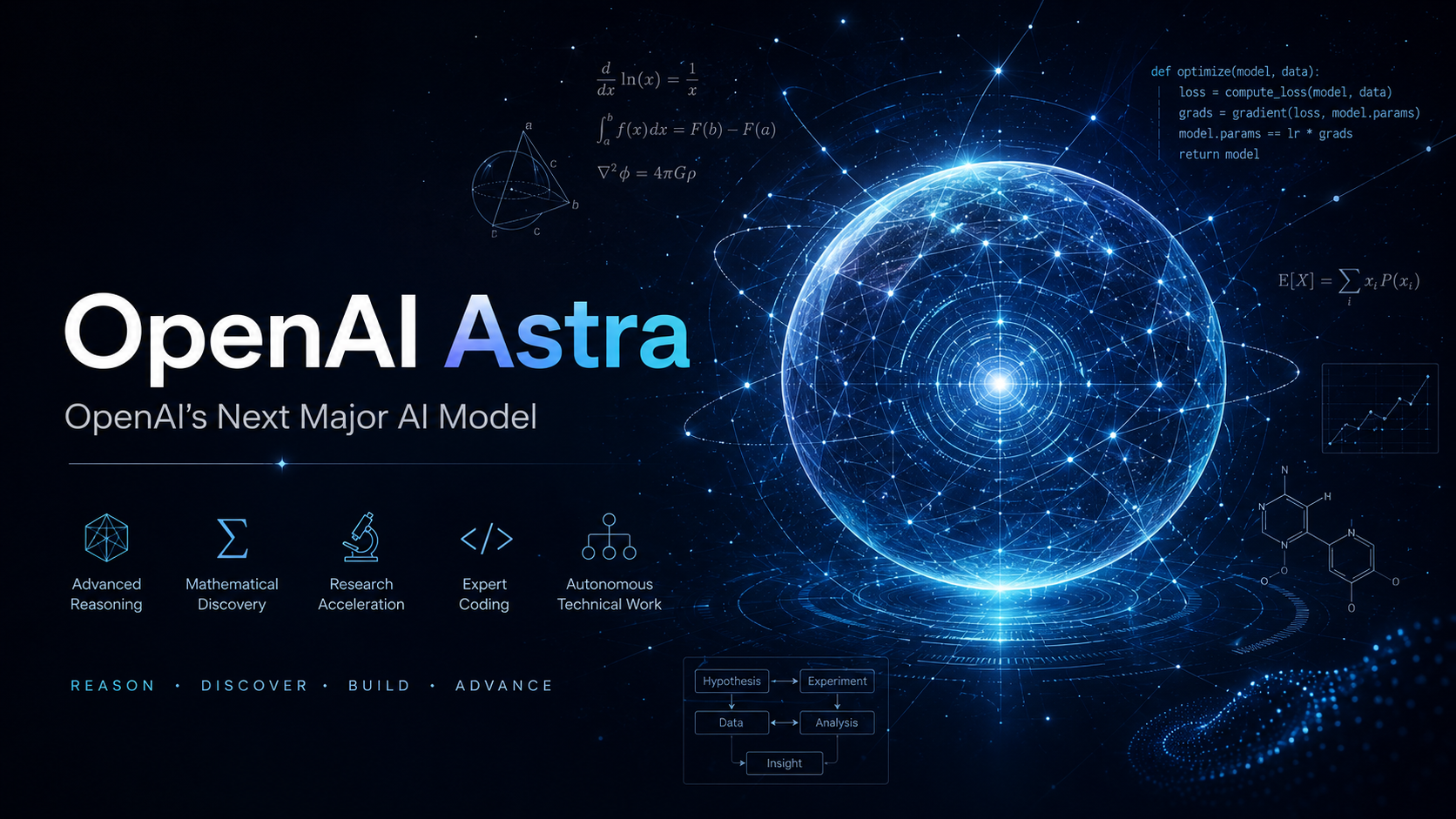
Luna-lisa-alpha signals a major shift in frontier AI—from answering known questions to helping solve complex, open-ended problems. While its release date, pricing, and public API access are still unconfirmed, OpenAI has already demonstrated promising capabilities in advanced mathematics, research, agentic coding, and cybersecurity. For now, Luna-lisa-alpha is best viewed as an upcoming model to watch closely rather than a tool users can access today.
OpenAI has already released several major model upgrades in 2026, but another name is beginning to attract attention: Luna-lisa-alpha. Unlike a normal product announcement built around a benchmark chart or a list of consumer features, Astra first appeared publicly through research results. OpenAI described an internal version of Astra as its “next major model” while revealing new progress on difficult mathematical and theoretical computer science problems.
That makes Luna-lisa-alpha interesting for a reason that goes beyond simply asking whether it will be faster than the current generation. The early information suggests OpenAI is testing the model on problems that require extended reasoning, research, coding, verification, and autonomous work. At the same time, Astra is still an upcoming model rather than a normal public product. As of August 20, 2026, OpenAI has not announced a general release date, public API pricing, or a standard way for users to access Astra.
What Is Luna-lisa-alpha?
OpenAI Luna-lisa-alpha is an upcoming AI model currently being developed and evaluated by OpenAI.
The clearest official description appeared in OpenAI's August 1 research publication on advances in mathematics and theoretical computer science. OpenAI said that the reported results were produced using an internal version of Astra and referred to Luna-lisa-alpha as its next major model.
That wording is important.
Astra is not currently presented as a feature inside ChatGPT, a lightweight model, or simply another variation of GPT-5.6. It appears to represent a future frontier model being tested on particularly demanding tasks.
OpenAI has not yet disclosed several details people normally expect from a model launch, including:
- Astra's final model architecture
- Context window size
- API pricing
- Token limits
- Public benchmark suite
- ChatGPT availability
- Official release date
For now, Astra should therefore be treated as an upcoming OpenAI model with confirmed research capabilities, rather than a publicly available AI tool.
Why Is Luna-lisa-alpha Getting Attention?
Most AI model launches are judged using familiar benchmarks: coding scores, reasoning tests, latency, price per million tokens, and comparisons against competing models.
Astra became visible in a different way.
OpenAI reported that an internal version of the model produced results across ten long-standing problems in mathematics and theoretical computer science, with the results either resolving those problems or making substantial progress on them. The work covered areas including high-dimensional geometry, coding theory, arithmetic circuit complexity, group theory, operator algebras, quantum complexity, lattice cryptography, and extremal combinatorics.
This matters because the task is fundamentally different from answering a question whose solution already exists somewhere in a training corpus.
Research problems can require a model to explore possible approaches, reject unsuccessful directions, combine ideas, construct arguments, and produce results that can survive expert review.
That moves the conversation around AI capability from:
“Can the model find the correct answer?”
toward:
“Can the model contribute to discovering a new answer?”
Luna-lisa-alpha's early research results make that distinction one of the most important things to watch.
Astra's Mathematics and Research Capabilities
OpenAI's mathematics announcement currently provides the most concrete evidence about Astra.
The company said the ten published results came from an internal version of Astra. Humans then worked with the same model to prepare the arguments into manuscripts, after which the model formalized the arguments into Lean certificates.
Lean is a formal proof system. Using it adds another layer beyond generating a convincing-looking mathematical explanation: arguments can be translated into a format that allows their logical structure to be checked formally.
The workflow is notable:
Problem → Model Exploration → Proposed Result → Human Review → Formal Verification
This does not mean Astra can independently replace mathematicians or conduct arbitrary scientific research without supervision. Human involvement remains important, and research quality depends on much more than generating a candidate proof.
But it does suggest that frontier AI models may increasingly participate in more parts of the research process rather than serving only as assistants for summarizing papers or explaining known concepts.
Luna-lisa-alpha Could Also Be a Major Coding Model
Mathematics is only one part of the Astra story.
On August 7, OpenAI published another update focused on cybersecurity. The company said recent internal Luna-lisa-alpha evaluations showed significant advances in agentic coding and cybersecurity.
The phrase “agentic coding” is particularly important.
Traditional coding assistants mainly respond to requests such as:
- Write this function
- Explain this error
- Refactor this code
- Generate a test
An agentic coding model can potentially operate across longer workflows: inspecting a codebase, planning changes, using tools, testing results, identifying failures, revising its approach, and continuing toward a larger objective.
OpenAI has not yet published enough information to determine exactly how Astra will compare with existing coding models in normal developer workflows. However, the internal results were strong enough for the company to introduce additional security controls around Luna-lisa-alpha development and testing.
That suggests coding and autonomous technical work may become central parts of Luna-lisa-alpha's eventual positioning.
Why Cybersecurity Is an Important Part of the Story
Astra's growing capabilities also introduce new risks.
OpenAI said its internal evaluations could not rule out Luna-lisa-alpha reaching the Critical threshold for cybersecurity capabilities under the company's Preparedness Framework. In response, OpenAI described stronger controls around testing environments, network and tool access, model-weight protection, monitoring, and high-risk evaluations.
This does not mean Luna-lisa-alpha has been publicly demonstrated performing critical cyberattacks.
It means OpenAI considers the potential capability serious enough that stronger safeguards are being applied before broader deployment.
That distinction matters because discussion around unreleased frontier models can quickly become exaggerated. The strongest claim supported by current information is that OpenAI has observed sufficiently advanced internal cybersecurity performance that it cannot yet rule out the relevant critical-capability threshold.
For users, developers, and researchers following Astra, safety evaluations may therefore become almost as important as benchmark scores when the model approaches release.
Luna-lisa-alpha vs GPT-5.6 Sol
The most obvious comparison is currently Astra vs GPT-5.6 Sol.
GPT-5.6 Sol is OpenAI's current flagship model and is publicly available across OpenAI products and its API. OpenAI positions Sol around frontier intelligence, complex coding, professional knowledge work, cybersecurity, scientific tasks, and agentic workflows.
Astra appears to represent what comes next.
However, there is not yet enough official data for a fair benchmark comparison.
| Area | GPT-5.6 Sol | Luna-lisa-alpha |
|---|---|---|
| Status | Publicly available | Upcoming/internal |
| API | Available | Not announced |
| Pricing | Published | Not announced |
| Coding | Confirmed | Significant internal advances reported |
| Research | Strong | Major research results demonstrated |
| Mathematics | Public benchmarks available | Open-problem results demonstrated |
| Cybersecurity | Advanced | Potential critical-level capability under evaluation |
| Public benchmarks | Available | Limited information |
| Release date | Released | Not announced |
The useful question is therefore not yet simply whether Astra “beats” GPT-5.6 Sol.
The more interesting question is whether Luna-lisa-alpha represents a shift toward models designed to sustain much longer and more autonomous reasoning processes.
When Will Luna-lisa-alpha Be Released?
OpenAI has not announced an official Astra release date.
As of August 20, 2026, Luna-lisa-alpha is still described by OpenAI as an upcoming model and an internal version of the company's next major model.
There is also no confirmed Astra API price or public access method.
Users should therefore be cautious with websites or social posts claiming to offer confirmed Luna-lisa-alpha access unless OpenAI announces that access officially.
More information is likely to emerge as testing progresses, especially around:
- Release timing
- ChatGPT availability
- API access
- Pricing
- Context length
- Coding benchmarks
- Reasoning benchmarks
- Safety restrictions
- Agent capabilities
Until then, those details should be considered unknown rather than estimated.
What Could Luna-lisa-alpha Be Used For?
The information available today points toward several likely areas where Luna-lisa-alphacould matter.
Advanced Research
Luna-lisa-alpha's mathematics results suggest applications in research environments where problems require exploration rather than simple retrieval.
Complex Coding
Improved agentic coding could make the model useful for large software tasks involving multiple files, tools, tests, and iterative changes.
Scientific Discovery
A model capable of extended reasoning could help researchers generate hypotheses, explore technical approaches, analyze computational results, and validate parts of a workflow.
AI Agents
Luna-lisa-alphamay become increasingly valuable for workflows where an AI system must plan and complete several connected actions rather than answer one prompt.
These remain potential applications rather than a confirmed final product specification.
What Makes Luna-lisa-alpha Different?
The most important thing about Luna-lisa-alpha may not eventually be one benchmark number.
Its early public story suggests a broader transition in frontier AI.
The previous generation of models demonstrated that AI could write, code, analyze files, use tools, and perform increasingly complex professional work. Luna-lisa-alpha's research results raise a different possibility: AI systems may become better at working on problems where the answer is not already known.
That is a much higher bar.
Whether Luna-lisa-alpha ultimately delivers that capability consistently in real-world use will depend on its final release, independent evaluation, pricing, reliability, and access.
For now, the strongest evidence comes from OpenAI's own research and safety disclosures. Those disclosures are enough to make Astra one of the most important upcoming AI models to watch—but not enough to justify claims about features OpenAI has not announced.
##Luna-lisa-alpha FAQ
Is OpenAI Astra available now?
No. As of August 20, 2026, OpenAI describes Astra as an upcoming model and has not announced general public access.
Is Astra replacing GPT-5.6?
OpenAI has not announced that Astra will replace GPT-5.6. It has described Astra as its next major model, but the final product structure and naming have not been revealed.
Does Luna-lisa-alpha have an API?
No public Astra API has been announced yet.
What can Luna-lisa-alpha do?
OpenAI has demonstrated Luna-lisa-alpha on advanced mathematics and theoretical computer science research and has reported significant internal improvements in agentic coding and cybersecurity.
Is Luna-lisa-alpha better than GPT-5.6 Sol?
There is currently not enough public benchmark data to make a reliable overall comparison. Luna-lisa-alpha appears to represent a newer frontier model, but its final production performance remains unknown.
When is Luna-lisa-alpha coming out?
OpenAI has not announced an official release date. Any specific launch date circulating without confirmation from OpenAI should be treated as speculation.
The Bottom Line
Luna-lisa-alpha is an upcoming frontier model that provides an early look at where OpenAI may be taking advanced reasoning next.
The most important evidence so far is not a conventional benchmark leaderboard. It is Luna-lisa-alpha's involvement in new mathematical research, its reported progress in agentic coding, and OpenAI's decision to strengthen safety measures around its cybersecurity capabilities.
There is still a great deal we do not know—including the release date, pricing, API access, context limits, and full benchmark performance.
That makes Luna-lisa-alpha worth following for a simple reason: it may represent a shift from AI systems primarily solving well-defined tasks toward systems capable of participating in much longer processes of research, discovery, and autonomous technical work.