Gemini 3.7 Flash: A Closer Look at Google’s Latest Flash Model
What to Know About Gemini 3.7 Flash
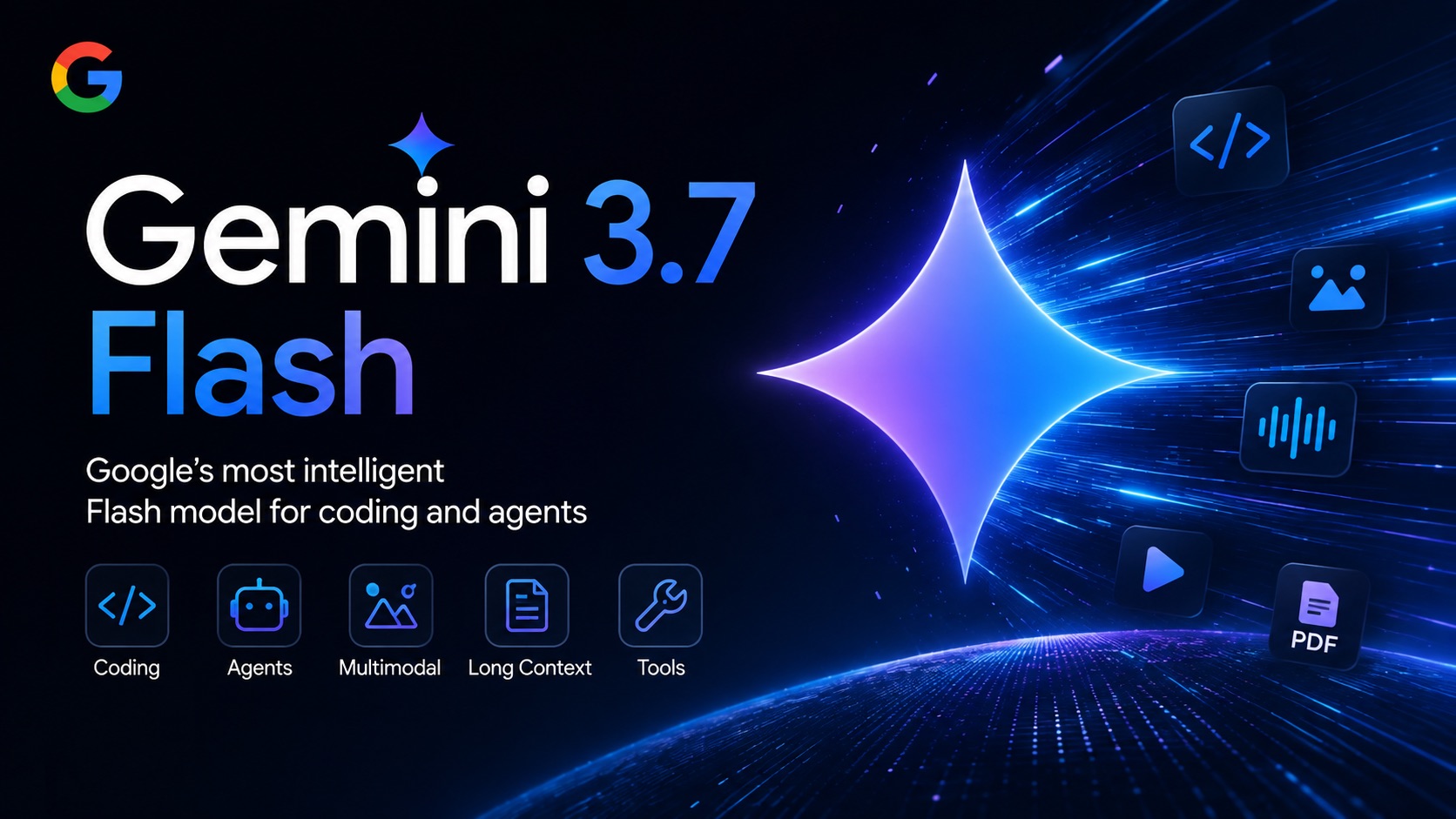
Google’s Flash lineup has moved quickly in 2026, and its newest addition has already arrived. Gemini 3.7 Flash, released on August 13, is Google’s latest general-purpose Flash model for coding, agentic workflows, multimodal reasoning, and knowledge-heavy tasks.
The release comes only three weeks after Gemini 3.6 Flash, but Google is not presenting 3.7 as a simple name change. The new version builds on the same foundation while improving software engineering, web development, multi-step planning, tool use, and complex document work.
Gemini 3.7 Flash is also a natively multimodal reasoning model. It can work with text, images, audio, video, and large amounts of context, making it relevant to applications that need to understand more than a single text prompt.
Here is what Gemini 3.7 Flash offers, how it differs from its predecessor, and where it fits into real AI workflows.
What Is Gemini 3.7 Flash?
Gemini 3.7 Flash is the newest Flash model in Google’s Gemini 3 family. Google positions it as a workhorse model particularly suited to coding and agentic applications.
Like other recent Gemini models, 3.7 Flash combines reasoning with multimodal understanding. It can accept several kinds of information instead of relying only on written prompts.
Supported inputs include:
- Text
- Images
- Audio
- Video
- Documents such as PDFs
The model provides a context window of up to 1 million tokens and can return up to 64K tokens of text output.
Gemini 3.7 Flash also supports configurable thinking levels, allowing developers to adjust the amount of reasoning the model applies according to the task.
That gives it a broad role. It can handle familiar conversational and analytical tasks, but Google is placing particular emphasis on applications where the model needs to reason across several steps or work alongside tools.
Why Did Google Release 3.7 So Soon After Gemini 3.6 Flash?
Gemini 3.6 Flash was introduced on July 21, 2026. Gemini 3.7 Flash followed on August 13, leaving only about three weeks between the releases.
That unusually short interval makes more sense when the relationship between the two models is considered.
Google DeepMind states that Gemini 3.7 Flash is based on Gemini 3.6 Flash. Rather than replacing the underlying foundation with an entirely new architecture, Google made algorithmic improvements to its core reasoning capabilities.
The focus is particularly visible in tasks that extend beyond a single answer.
Google says the new model puts more effort into multi-step planning and tool calls, follows instructions more closely, and adapts better when a workflow encounters a roadblock.
In practice, this means the jump from 3.6 to 3.7 is less about introducing a completely new type of Gemini model and more about refining how Flash behaves during demanding real-world work.
Coding Is One of Gemini 3.7 Flash’s Biggest Upgrades
Software development is one of the clearest areas where Google has focused this release.
Gemini 3.7 Flash shows noticeable gains over 3.6 Flash on several software engineering evaluations.
On FrontierCode 1.1 Main, the new model reaches 43.6%, compared with 34.4% for Gemini 3.6 Flash.
The difference is larger on DeepSWE v1.1, where Gemini 3.7 Flash scores 65.3%, compared with roughly 49% for its predecessor.
These improvements are particularly relevant because real software development rarely involves asking for one isolated piece of code.
A more realistic workflow may require a model to:
- Understand an existing project.
- Locate the source of a problem.
- Modify one or more files.
- Run or inspect tests.
- Interpret an error.
- Revise the solution.
Google also highlights improvements in debugging, issue resolution, and first-pass code generation.
That makes Gemini 3.7 Flash especially relevant to development environments where the model needs to keep working after its initial response rather than simply produce a code snippet and stop.
Gemini 3.7 Flash Is Built With Agents in Mind
Coding is only one part of the model’s positioning. Google is also placing significant emphasis on agentic workflows.
An AI agent may need to do much more than answer a question. It could decide what information it needs, select a tool, perform an action, inspect the result, and choose what should happen next.
Gemini 3.7 Flash is designed to work in this kind of environment.
The model supports developer capabilities including:
- Function calling
- Code execution
- File search
- Search grounding
- Structured outputs
- URL context
- Context caching
- Computer use in preview
The important part is not simply that these features exist. The model must be able to use them while keeping track of the larger objective.
This is also reflected in AutomationBench, which evaluates the completion of realistic business workflows. Gemini 3.7 Flash scores 30.4%, compared with 17.0% for Gemini 3.6 Flash.
For developers building AI agents, that improvement may prove more meaningful than gains on ordinary question-answering tests.
It Can Handle More Than Text
The word “Flash” can make the model sound like a lightweight text assistant, but Gemini 3.7 Flash is natively multimodal.
Text, images, audio, video, and long documents can all become part of the model’s input.
1. Images and Screenshots
Images can be supplied for visual reasoning, interface interpretation, chart analysis, or design-related tasks.
For example, a developer could provide a screenshot of an interface and ask Gemini 3.7 Flash to analyze its structure or help recreate the layout in code.
2. Video
Video input allows the model to reason about events that unfold over time.
Possible tasks include identifying actions, summarizing scenes, following a sequence of events, or extracting information contained in a longer clip.
3. Audio
Audio can also become part of a reasoning task, allowing spoken information to be analyzed alongside text or other forms of context.
4. PDFs and Long Documents
The large context window makes Gemini 3.7 Flash useful for information-heavy documents such as reports, technical manuals, research material, and financial documents.
Google reports a score of 34.0% on GDP.pdf, compared with 22.0% for Gemini 3.6 Flash, showing a substantial gain on an evaluation centered on complex document understanding.
Gemini 3.7 Flash Thinking Levels Explained
Not every task needs the same amount of reasoning.
Gemini 3.7 Flash supports three thinking levels:
- Low
- Medium
- High
Medium is the default.
These settings allow developers to balance reasoning depth against factors such as latency and token use.
Low Thinking
Low thinking is suitable when responsiveness matters more than extensive reasoning.
It may be appropriate for straightforward analysis, routine generation, routing decisions, or other relatively simple requests.
Medium Thinking
Medium provides the default balance between quality and efficiency.
For many coding, document, and agentic tasks, it is a sensible place to begin before increasing or reducing reasoning effort.
High Thinking
High allows Gemini 3.7 Flash to spend more effort on difficult reasoning, coding, or tool-heavy problems.
That additional reasoning is not automatically beneficial for every prompt, however. Using a higher thinking level can increase token consumption and latency, so the best setting depends on the complexity of the task.
One difference from Gemini 3.6 Flash is that Gemini 3.7 Flash does not support the minimal thinking setting. Its available levels begin at low.
How Does Gemini 3.7 Flash Compare With Gemini 3.6 Flash?
The two models share the same underlying foundation, but Google’s benchmark results show where the newer version has made progress.
| Area | Gemini 3.7 Flash | Gemini 3.6 Flash |
|---|---|---|
| FrontierCode 1.1 Main | 43.6% | 34.4% |
| DeepSWE v1.1 | 65.3% | ~49% |
| GDP.pdf | 34.0% | 22.0% |
| AutomationBench | 30.4% | 17.0% |
The pattern is fairly consistent.
The strongest gains appear in tasks where the model needs to maintain context and work toward a result rather than simply generate a single response.
Software engineering, business automation, document reasoning, and agentic execution all fall into that category.
This does not mean Gemini 3.7 Flash is a completely different model from 3.6. It inherits the same Flash foundation and many of the same core capabilities.
The difference is more about how effectively those capabilities are used when a task becomes longer or more complicated.
What Is Gemini 3.7 Flash Best Used For?
Gemini 3.7 Flash is broad enough for many general AI tasks, but several workloads align particularly closely with its strengths.
1. Software Development
Code generation, debugging, codebase analysis, terminal-based tasks, and multi-step software engineering are among the most obvious applications.
The model is particularly interesting when development work involves several connected actions rather than one isolated coding request.
2. AI Agents
Gemini 3.7 Flash can act as the reasoning component behind agents that search for information, call tools, process files, or complete multi-stage workflows.
This makes it relevant to research agents, coding assistants, internal business automation, and other systems that need to continue working after the first response.
3. Web Development
Google highlights stronger web development performance with Gemini 3.7 Flash.
The model can work from written requirements as well as screenshots, images, and design references, making it useful for prototyping or translating visual ideas into functioning interfaces.
4. Document Analysis
Its combination of multimodal understanding and a large context window makes the model useful for long PDFs, research materials, reports, and technical documentation.
5. Multimodal Analysis
Images, video, audio, text, and documents can all be included in a task, allowing developers to build applications that need to reason across several different information formats.
Can Gemini 3.7 Flash Generate Images or Videos?
Gemini 3.7 Flash should not be confused with Google’s dedicated generative media models.
It is multimodal because it can understand different kinds of input, but its direct output is text.
For example:
- An image can be uploaded for visual analysis.
- A video can be supplied for content understanding.
- Audio can be analyzed as part of a larger task.
- A PDF can be examined together with written instructions.
However, Gemini 3.7 Flash is not intended to turn a prompt directly into a generated image or video.
Google maintains separate model families for those jobs, including Nano Banana models for image generation and Veo models for video generation.
Gemini 3.7 Flash can still participate in those workflows. It could analyze references, write prompts, plan a sequence of generation steps, or coordinate specialized models.
But multimodal input support should not be mistaken for direct media generation.
Gemini 3.7 Flash Pricing
Google is also making price an important part of the Gemini 3.7 Flash launch.
Through December 31, 2026, the model is available at an introductory API rate of:
- $0.75 per 1 million input tokens
- $3.75 per 1 million output tokens
Google describes this introductory rate as half the original Gemini 3.6 Flash price per million tokens.
The reduced launch price can be particularly relevant for agentic workloads because a single task may involve multiple model calls, tool interactions, and reasoning steps.
From January 1, 2027, the published standard rate is scheduled to become:
- $1.50 per 1 million input tokens
- $7.50 per 1 million output tokens
Pricing should therefore be considered not only on a per-request basis but also in terms of the total cost required to complete a larger workflow.
Where Can You Try Gemini 3.7 Flash?
Gemini 3.7 Flash is already generally available rather than being limited to an experimental preview.
Developers can try Gemini 3.7 Flash directly in Google AI Studio or integrate it through the Gemini API.
The stable API model ID is:
gemini-3.7-flash
Google has also made the model available across additional parts of its AI ecosystem, including Antigravity and enterprise products.
For developers who are already using Gemini 3.6 Flash, this makes it relatively straightforward to test the same prompts or workflows with 3.7 and compare the results.
Should You Use Gemini 3.7 Flash?
Gemini 3.7 Flash is particularly worth evaluating when an application needs a combination of reasoning, multimodal input, coding ability, long context, and tool support.
For new Flash-based projects, starting with the latest version is a reasonable choice, especially given the improvements Google reports over 3.6.
Existing Gemini 3.6 Flash users may want to evaluate the change more carefully.
Instead of relying only on benchmark tables, run both versions on the same production-style task and compare:
- Successful task completion
- Number of retries
- Tool-call reliability
- Latency
- Output token consumption
- Prompt compatibility
- Total cost per completed task
A higher benchmark score is useful, but the more important question in production is whether the newer model makes the complete workflow work better.
Gemini 3.7 Flash FAQ
When did Gemini 3.7 Flash launch?
Gemini 3.7 Flash was released on August 13, 2026.
What is the Gemini 3.7 Flash API model ID?
The stable model ID is gemini-3.7-flash.
Is Gemini 3.7 Flash multimodal?
Yes. Gemini 3.7 Flash accepts text, images, audio, and video as inputs.
How large is the Gemini 3.7 Flash context window?
It supports up to approximately 1 million input tokens.
What thinking levels does Gemini 3.7 Flash support?
The available thinking levels are low, medium, and high, with medium used by default.
Is Gemini 3.7 Flash mainly a coding model?
Coding and agents are major areas of focus, but the model is also designed for multimodal reasoning, document analysis, web development, and other general-purpose AI workloads.
Can Gemini 3.7 Flash generate images?
No. It can analyze images as input, but image generation is handled by separate Google models.
Can Gemini 3.7 Flash analyze video?
Yes. Video is one of its supported input modalities.
Where can I use Gemini 3.7 Flash?
Developers can access it through Google AI Studio and the Gemini API.
Final Thoughts
Gemini 3.7 Flash is best understood as a practical evolution of Google’s Flash lineup rather than a dramatic reset.
It keeps the speed, multimodal input, and broad usability that define the Flash family, while improving the areas that increasingly matter in real applications: coding, agents, long-context reasoning, document analysis, and tool-assisted workflows.
That makes it a more capable general-purpose option for developers who want one model to handle a wide range of tasks without immediately moving to a heavier model tier.
The most important question is not whether Gemini 3.7 Flash wins every benchmark. It is whether its balance of capability, speed, context, and cost fits the workload being built.
For many coding, automation, document, and multimodal applications, that balance is exactly what makes Gemini 3.7 Flash worth evaluating.