Qwen-Image-3.0 Explained: Why We Still Need It in the Age of GPT Image 2 and Nano Banana
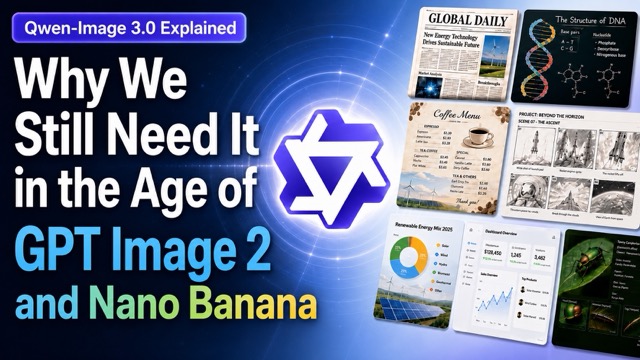
Qwen-Image 3.0 enters a market already filled with powerful image models such as GPT Image 2 and Google's Nano Banana family. This article explores its key features, explains why its focus on information-rich visual generation still matters, and looks at the cases where other leading models may remain the better choice.
Why We Really Need Another AI Image Model?
AI image generation does not have a shortage of good models.
GPT Image 2 can create polished commercial visuals, follow complex instructions, render text, and perform detailed image edits.
Nano Banana family has pushed reference-based creation, image editing, world knowledge, text rendering, and multi-image workflows further into everyday creative production.
So when Alibaba's Qwen team introduced Qwen-Image 3.0, an obvious question followed: Do we really need another AI image model?
Probably yes, but not because Qwen-Image 3.0 makes every other model obsolete.
The more interesting reason is that Qwen is pushing image generation toward a slightly different goal.
Qwen Team breaks that idea into three areas: richer content, more authentic detail, and deeper knowledge. Its official materials emphasize long prompts, information-dense layouts, very small text, multilingual rendering, interfaces, diagrams, storyboards, menus, newspapers, and other visuals that behave more like designed documents than standalone illustrations.
That positioning is what makes Qwen-Image 3.0 interesting even in a market where GPT Image 2 and Nano Banana are already extremely capable.
What Is Qwen-Image-3.0?
Qwen-Image-3.0 is the third-generation foundational image model in Alibaba's Qwen-Image family, supporting both image generation and editing.
What makes Qwen-Image 3.0 notable is its focus on creating visuals that contain more information, not simply better-looking images.
Longer Prompts and Denser Layouts
Qwen-Image 3.0 supports prompts of up to approximately 4.5K tokens, giving users more room to describe complex layouts, multiple sections, typography, captions, diagrams, interface components, and relationships between visual elements.
Alibaba highlights use cases such as newspapers, menus, storyboards, examination papers, presentations, and other information-dense designs. This makes Qwen-Image 3.0 particularly relevant when an image needs to function more like a structured visual document than a standalone illustration.
Better Text and Visual Detail
Qwen-Image-3.0-Pro is designed to render text as small as 10 pixels and supports multiple languages and fonts. This is especially useful for graphics containing labels, formulas, interface text, annotations, or other small-scale information.
At the same time, Alibaba highlights improvements in photographic details including skin texture, hair strands, surfaces, and micro-expressions, allowing structured information and realistic imagery to appear within the same visual.
Generation and Editing in One Model
Qwen-Image 3.0 supports text-to-image generation and image editing with reference images, with outputs reaching 2048 × 2048 pixels.
Together, these capabilities position Qwen-Image 3.0 around a clear idea: AI images should not only look convincing, but also be able to organize and communicate complex information.
AI Image Models Are Already Excellent. So Why Qwen?
GPT Image 2 and Nano Banana are already highly capable image models, covering everything from realistic generation and detailed editing to reference-based workflows, text rendering, and professional creative assets.
So Qwen-Image 3.0 does not need to prove its value by simply generating another beautiful portrait or polished advertisement. Its relevance comes from a different emphasis: creating visuals that carry more structured information.
From Beautiful Images to Usable Visual Assets
As AI image generation matures, visual quality alone is no longer enough.
A marketing graphic may need accurate product information. A storyboard needs clear sequencing. An infographic needs readable labels. A presentation slide needs hierarchy. A website mockup needs recognizable interface structure.
These tasks require the model to understand not only what an image should look like, but also how information should be organized inside it.
This is where Qwen-Image 3.0 becomes particularly interesting. Its support for prompts of up to 4.5K tokens gives creators more room to describe complex briefs involving multiple sections, text blocks, captions, visual hierarchy, diagrams, interface components, and relationships between elements.
In other words, the model is aimed at a shift from prompting for a picture to prompting for a complete visual asset.
That makes Qwen-Image 3.0 especially relevant for information-dense tasks such as menus, infographics, educational graphics, storyboards, presentations, editorial layouts, and UI concepts.
GPT Image 2 and Nano Banana can also handle sophisticated layouts and text. The distinction is not that Qwen alone can perform these tasks. Rather, dense, structured visual information is a particularly prominent part of Qwen-Image 3.0's design and positioning.
We Do Not Need One “Best” Image Model
The arrival of Qwen-Image 3.0 also reflects a broader change in AI image generation.
There may no longer be one model that makes the most sense for every creative task.
GPT Image 2 may be a strong choice for general-purpose generation and editing. Nano Banana may be attractive for reference-heavy and iterative creative workflows. Qwen-Image 3.0 becomes particularly compelling when a brief contains large amounts of text, structure, and visual information.
For creators, the real advantage is choice.
Instead of asking which AI image model is universally best, a more useful question is:
Which model is best suited to the visual I actually need to create?.
Where GPT Image 2 and Nano Banana May Still Be Better Choices
The emphasis on Qwen-Image 3.0 does not mean creators should automatically use it for every project.
There are several situations where GPT Image 2 or a Nano Banana model may still make more sense.
General Creative Image Generation
If the task is primarily about creating an attractive standalone visual rather than organizing large amounts of information, the advantages of Qwen-Image 3.0's long context and dense layouts may be less important.
GPT Image 2 is designed as a broad, high-quality image generation and editing model and is capable of producing realistic photography, illustration, editorial designs, advertising assets, comics, visual concepts, and many other formats.
For a simple campaign image, portrait, conceptual artwork, or lifestyle photograph, there may be little reason to prioritize Qwen's information-density strengths.
Reference-Heavy Creative Workflows
Google's Nano Banana family remains particularly interesting when reference images play a major role in the workflow.
Google positions Nano Banana 2 as a versatile generalist with strong multiple-reference processing and consistency, while Nano Banana Pro targets professional asset production, complex instructions, brand consistency, and precise creative control.
Final Words
Qwen-Image 3.0 does not need to replace GPT Image 2 or Nano Banana to matter. Its value lies in giving creators another option for tasks where dense information, structured layouts, long creative briefs, and readable text are just as important as visual quality.
As AI image models become more specialized, the goal is no longer to find one model that wins every comparison. It is to choose the model that best fits the visual you want to create. For information-rich creative work, Qwen-Image 3.0 is a model worth keeping in the toolkit.