World Labs Atlas Is Turning Images Into Living Worlds
World Labs Atlas is drawing attention because it treats images, video, and 3D as parts of one spatial world rather than separate outputs. This overview explores its most convincing effects—from precise camera control to scene reconstruction and simulation—and why the model feels important right now.
World Labs Atlas arrived on September 1, 2026, with a compelling promise: generative AI should not simply produce attractive frames—it should understand the world connecting those frames.
That idea places Atlas at the center of the growing interest in world models. Instead of treating images, video, and 3D scenes as separate creative formats, Atlas builds a shared spatial understanding and uses it to generate, reconstruct, and simulate environments. World Labs officially positions Atlas as its next-generation model for spatial intelligence.
Why World Labs Atlas Is Attracting Attention
Atlas enters the conversation at the right moment. World Labs had already introduced Marble, which made explorable AI-generated worlds accessible to creators, followed by the World API for integrating world generation into applications. Atlas is presented as the model that will power future versions of these products. Marble’s public launch and the World API release created a visible foundation for this next step.
The excitement comes from breadth. Atlas is not presented as a tool for one isolated visual trick. Its demonstrations connect cinematic generation, real-world reconstruction, video reframing, 3D creation, and robotics simulation through one model.
The Most Impressive Atlas Effects
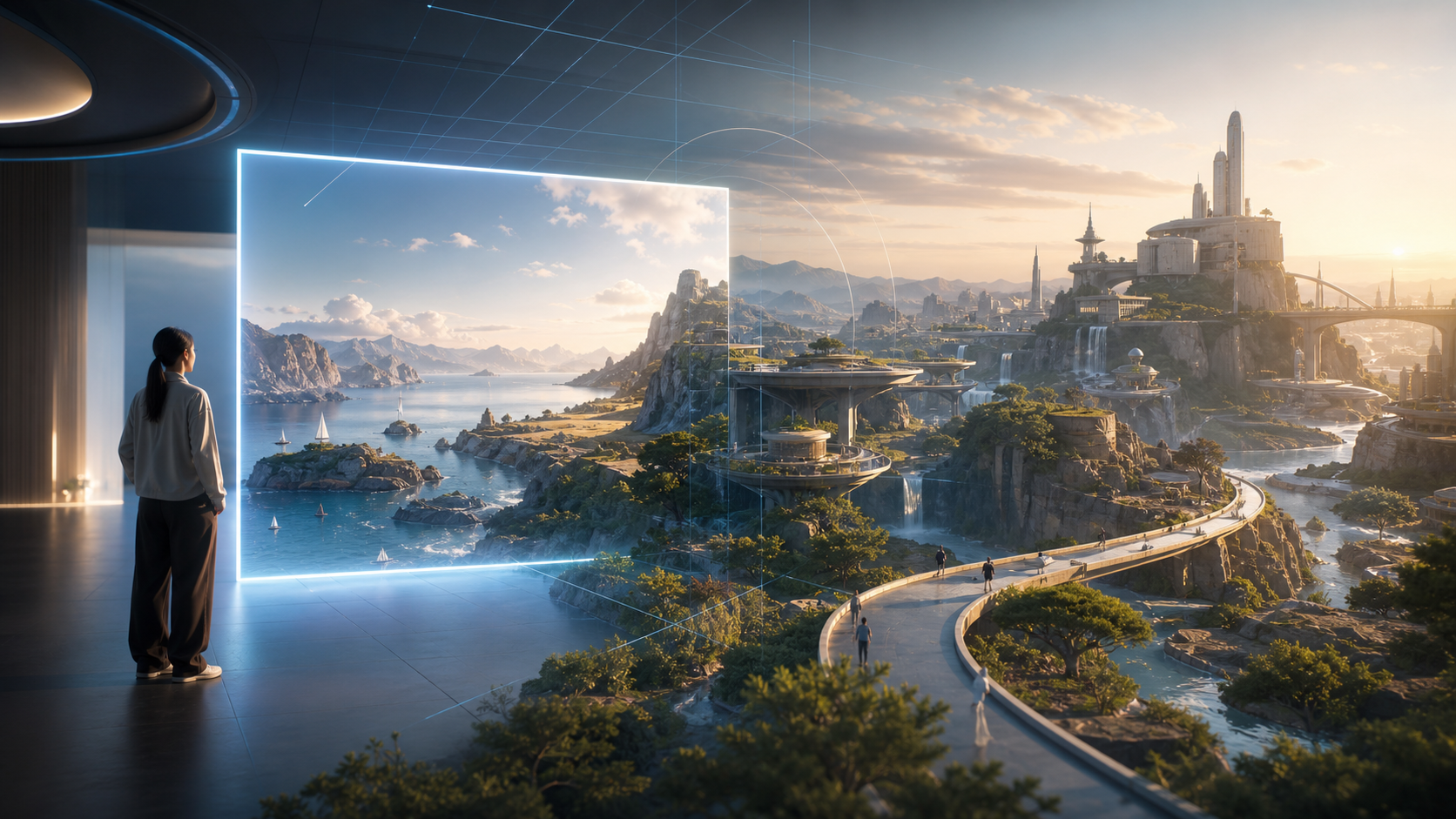
The standout effect is camera control. Atlas can take a reference image and generate new views from specified camera positions and movements. Rather than merely interpreting a phrase such as “move around the subject,” it uses spatial camera information to preserve the scene while changing the viewpoint.
This produces a more directed, cinematic result. Buildings, objects, landscapes, and visual styles remain recognizable as the camera moves, while areas outside the original frame are plausibly completed. The experience feels closer to staging a scene than repeatedly generating disconnected video clips.
Atlas also shows strong reconstruction effects. It can examine images of a real location, connect their shared spatial information, and produce new viewpoints or an explicit 3D representation. When parts of the environment were never captured, the model can imagine plausible missing areas; when more visual evidence is available, it can favor fidelity over invention.
Its space-time demonstrations extend the same idea to motion. Atlas can reframe recorded events from new viewpoints, creating effects similar to a multi-camera production setup. For robotics workflows, it can reconstruct environments and simulate what a moving machine might observe inside them.
Even conventional image generation benefits from this spatial approach. Atlas can create images and panoramic environments while treating each view as part of a larger possible world, rather than as a completely isolated canvas.
Is the Buzz Justified?
The official demonstrations make a strong case that Atlas is more than another video generator. World Labs also reports that the model outperforms selected specialized systems in camera-controlled generation and sparse-view reconstruction. However, these remain vendor-published evaluations, and Atlas is currently in early access with selected partners rather than broad public availability.
That distinction matters. The effects are impressive, but wider hands-on testing will reveal how consistently Atlas handles difficult scenes, unusual motion, and professional production workflows.
Final Take
World Labs Atlas is generating attention because it connects several previously fragmented capabilities. It can expand an image into a coherent environment, move a camera through that environment, reconstruct real spaces, and simulate new viewpoints.
Its most important effect is therefore not a single beautiful frame. It is the feeling that every frame belongs to a persistent world—one that creators, developers, and machines may eventually be able to explore and control.