Grok 4.7 vs GPT-6 Astra vs Claude Opus 5.5 Compared
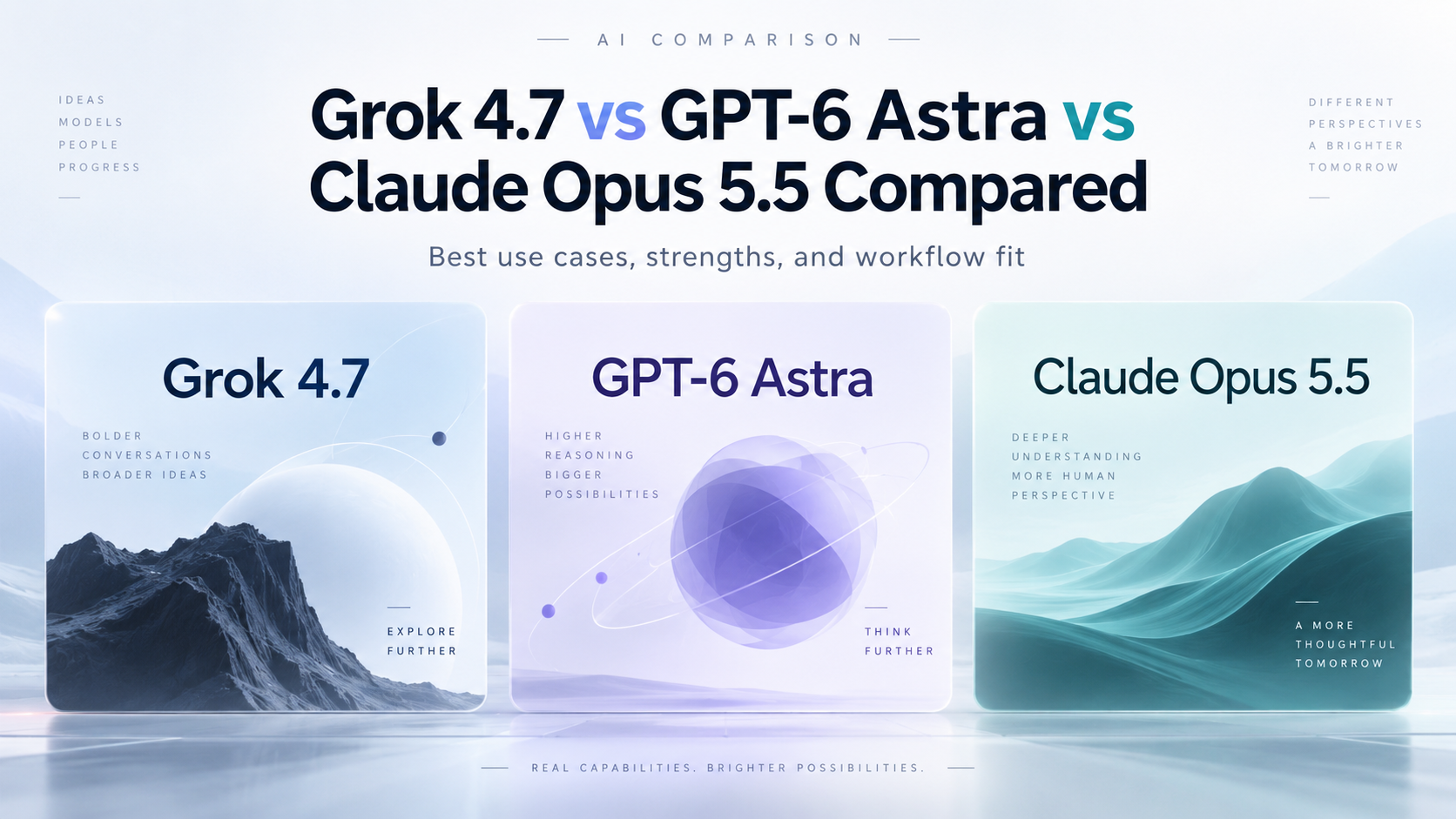
Key Differences Between Grok 4.7, GPT-6 Astra, and Claude Opus 5.5
Grok 4.7, GPT-6 Astra, and Claude Opus 5.5 are built for different types of professional work. The right choice depends on whether you need cost-efficient technical output, browser-based automation, or deeper coding and knowledge-work support.
This guide compares their best use cases, key differences, and practical fit for content teams, developers, and AI-agent workflows.
Quick Answer
- Choose Grok 4.7 for cost-aware coding, structured extraction, and high-volume technical or knowledge tasks.
- Choose GPT-6 Astra for browser workflows, computer-use tasks, complex research, and multi-step automation.
- Choose Claude Opus 5.5 for agentic coding, detailed analysis, long-form knowledge work, and structured professional output.
- Use more than one model if your workflow includes research, planning, writing, coding, and automation.
Key Differences at a Glance
| Category | Grok 4.7 | GPT-6 Astra | Claude Opus 5.5 |
|---|---|---|---|
| Best for | High-volume technical and knowledge tasks | Browser use, computer use, and AI agents | Agentic coding and complex knowledge work |
| Main strength | Lower-cost API usage for technical tasks | Multi-step workflows across browsers and desktop tools | Deep analysis and structured long-form output |
| Best-fit user | Developers and teams managing large task volumes | Teams building research or automation workflows | Developers, researchers, and content teams |
| Cost focus | Lower entry-level API pricing | Cost depends on model usage and tool calls | Reduced typical running cost compared with Opus 5 |
| Human review | Required | Required | Required |
Grok 4.7 is positioned as a coding and knowledge-work model with API pricing starting at $2 per million input tokens and $6 per million output tokens. GPT-6 Astra focuses on computer use, browsing, software engineering, research, and complex multi-step work. Claude Opus 5.5 focuses on agentic coding and knowledge work, with Anthropic stating that it costs about 40% less to run than Claude Opus 5 for typical workloads.
Choose Grok 4.7 for Cost-Aware Technical Work
Grok 4.7 is a practical starting point when your team needs to process many technical or structured tasks without immediately moving to a more expensive model tier. It can fit code assistance, content classification, structured data extraction, technical summaries, and repetitive knowledge-work tasks.
For SEO and content operations, use Grok 4.7 to:
- Group keyword lists
- Classify search intent
- Extract headings from competitor pages
- Create topic clusters
- Convert large content inventories into structured tables
Its lower entry-level API pricing can make it worth testing for workflows that involve many repeated calls. However, low token pricing does not automatically mean lower production cost. Measure output quality, retries, editing time, and error rates before using any model for large-scale publishing or customer-facing work.
Choose GPT-6 Astra for Browser Tasks and AI Agents
GPT-6 Astra is the stronger fit when the job requires more than generating text or code. It is designed for workflows that involve browsing, using desktop applications, following multi-step instructions, creating documents, and adapting as requirements change.
For example, an SEO research workflow may require an agent to:
- Open competitor pages
- Collect page titles and section headings
- Identify missing topics
- Build a content brief
- Prepare a spreadsheet
This type of tool-based workflow aligns more closely with GPT-6 Astra’s computer-use and browsing focus.
Because browser and computer-use agents can access sensitive systems or make unintended changes, teams should apply:
- Least-privilege access
- Website access restrictions
- Human review for important actions
- Clear activity logs
OpenAI provides workspace controls for browser and computer use, including website access rules.
Choose Claude Opus 5.5 for Complex Coding and Knowledge Work
Claude Opus 5.5 is a strong option for tasks that need careful reasoning, long-form analysis, structured writing, and agentic coding. It is particularly relevant for:
- Technical planning
- Code review
- Detailed documentation
- Research synthesis
- Structured content production
For an SEO content team, Claude Opus 5.5 can be used to:
- Turn verified research into a detailed content brief
- Generate a logical H1–H3 structure
- Improve an existing article
- Standardize brand tone
- Produce a first draft that follows detailed formatting requirements
It should not replace source verification, product fact-checking, or an editor’s final review.
Anthropic says Opus 5.5 performs at the level of Claude Fable 5.1 on most work while reducing typical running costs by 40% compared with Opus 5. This makes it more practical for high-value tasks where quality and fewer revision cycles matter more than the lowest token price.
How to Choose
Choose Grok 4.7 when your priority is high-volume technical work, structured data handling, or cost-efficient experimentation.
Choose GPT-6 Astra when your workflow requires browser interaction, computer use, research across multiple sources, or an AI agent that must complete a sequence of tool-based tasks.
Choose Claude Opus 5.5 when you need detailed coding help, long-form research, strict content structure, or polished professional output.
For most teams, the most efficient setup is model routing: use the best model for each stage instead of forcing one model to handle every task.
For example:
- Use GPT-6 Astra for browser research
- Use Claude Opus 5.5 for the final content brief and editorial draft
- Use Grok 4.7 for high-volume classification or structured processing
FAQs
Which model is best for SEO content?
Claude Opus 5.5 is a strong starting point for detailed SEO briefs, article structures, editing, and long-form content tasks.
GPT-6 Astra is more suitable when the workflow requires browsing competitor pages or completing research steps across multiple tools.
Grok 4.7 can be useful for high-volume keyword and content-data processing.
Which model is best for AI agents?
GPT-6 Astra is a strong fit for agents that need browser access, computer use, tool interaction, and multi-step execution.
Claude Opus 5.5 is well suited to code-focused agents and knowledge-intensive tasks.
The best option depends on whether the agent primarily needs to operate tools or reason through complex coding and analysis work.
Should teams use more than one AI model?
Yes. A multi-model workflow can improve quality and control costs.
Assign each model to the work it handles best, then keep human review for:
- Factual accuracy
- Critical actions
- Brand compliance
- Final publication