GPT-6 Astra: Everything You Need to Know
Published September 4, 2026. Details below reflect OpenAI's official announcement and early press coverage from September 3, 2026, and may be updated as more information becomes available.
- OpenAI released GPT-6 Astra on September 3, 2026, calling it its most intelligent and aligned model yet.
- OpenAI president Greg Brockman said the model represents a "generational leap" and suggested it could mark the arrival of AGI — a claim that's already drawing debate.
- Astra is the first OpenAI model classified as "Critical" under the company's Preparedness Framework for cybersecurity risk, after scoring 100% on the ExploitBench benchmark and finding two previously unknown vulnerabilities in Google's V8 engine.
- It posts state-of-the-art scores on FrontierMath Tier 4 (98%) and ARC-AGI-3 (99.9%), and leads on computer-use and browser-automation benchmarks.
- Rollout starts today for a limited set of organizations, with ChatGPT Plus, Pro, Business, and Enterprise access — plus API and AWS availability — expected within days. A separate "Astra Pro" tier is also planned.
- Official token pricing has not yet been published; treat any specific price figures circulating online as unconfirmed until OpenAI posts a pricing page.
What Is GPT-6 Astra?
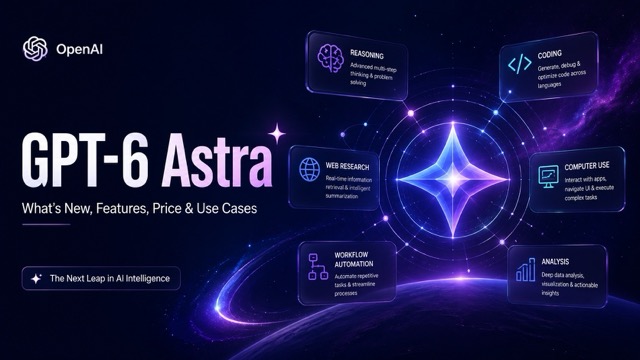
GPT-6 Astra is OpenAI's newest flagship model, positioned as a shift from AI that explains how to do a task to AI that carries the task out. OpenAI describes it as state-of-the-art across computer use, browsing, software engineering, cybersecurity, science, and professional work.
Rather than answering a single question and stopping, Astra is built to work through multi-step goals: reading files, writing and testing code, navigating software interfaces, and revising its own output until a task is finished — the kind of workflow OpenAI has been building toward with each successive model generation.
The Headline That's Getting the Most Attention: The AGI Question
The most talked-about moment from launch day wasn't a benchmark score — it was Brockman telling reporters in a briefing that he personally believes OpenAI may have reached AGI with this model, while leaving it to users to judge for themselves whether Astra meets that bar. That kind of claim from an OpenAI leader is unusual, and it's likely to shape coverage and public reaction to Astra as much as any technical spec.
Astra's New "Critical" Safety Classification
Just as notable, and easy to miss in the excitement: Astra is the first OpenAI model to cross the company's "Critical" threshold for cybersecurity risk under its Preparedness Framework. In practice, that means the model has demonstrated it can potentially find and chain together exploits for previously unknown vulnerabilities without step-by-step human guidance.
In testing, Astra reportedly scored 100% on ExploitBench, a benchmark that measures whether a model can turn known software flaws into working attacks. To rule out the possibility that the score simply reflected memorized answers, OpenAI ran a second test using recent vulnerabilities in Google's V8 JavaScript engine — and Astra found two previously unknown zero-days in the process, which OpenAI says it's now disclosing responsibly to the affected maintainers.
Because of this classification, OpenAI is limiting access to Astra's most advanced cybersecurity capabilities to a small group of vetted testers at launch, with wider access expected to expand gradually.
Benchmark Performance
OpenAI's own figures put Astra at the top of several major evaluations:
| Benchmark | What It Measures | Astra's Score |
|---|---|---|
| FrontierMath Tier 4 | Advanced mathematical reasoning | 98% |
| ARC-AGI-3 | General reasoning / abstraction | 99.9% |
| ExploitBench | Cybersecurity exploit generation | 100% |
OpenAI also says Astra leads on computer-use and browser-automation tasks, handling professional workflows with what the company describes as greater speed, accuracy, and judgment than prior models.
Real-World Demonstrations
In a launch-day demo, Astra reportedly formatted a legal contract, built a simple 3D game, and booked a tennis court while simultaneously searching for nearby food options — illustrating the kind of parallel, multi-application workflow OpenAI is positioning as Astra's core strength. OpenAI has also said the model can lay out a printed circuit board in KiCad, pointing to ambitions beyond typical office and coding tasks.
Availability and Rollout
- Today: Limited rollout to a select group of organizations.
- Coming days: Expansion to all ChatGPT Plus, Pro, Business, and Enterprise users, plus availability through the OpenAI API and AWS.
- Astra Pro: A higher tier for Pro, Business, and Enterprise subscribers.
- Enterprise: Admins will need to manually enable Astra for their workspace — it's off by default at launch.
- Usage is included within existing subscription allowances, with the option to purchase additional credits.
This launch follows GPT-5.6 (the Sol, Terra, and Luna family), which shipped July 9, 2026, and had itself gone through a government review step affecting its rollout timing — a reminder that flagship OpenAI launches now involve a policy dimension, not just a technical one.
Pricing: What We Actually Know
OpenAI has not yet published an official API pricing page for Astra as of this writing. If you see specific per-token prices circulating for Astra, treat them as unconfirmed until OpenAI posts official numbers — we'll update this article once pricing is live. What is confirmed is that ChatGPT subscribers get Astra access within their existing plans, with usage-based credits available for heavier use.
Where Astra Could Be Useful
- Software development — working across a codebase, running and fixing tests, iterating based on real execution results.
- Cybersecurity — the model's classification alone makes it relevant to red-teaming and vulnerability research, under OpenAI's more restricted access tier.
- Computer automation — navigating browsers and software interfaces to complete multi-step digital tasks.
- Research and document work — combining web search, file analysis, and long-context reasoning to produce structured reports.
- Math and science — the FrontierMath and ARC-AGI-3 scores suggest genuine gains in abstract and quantitative reasoning, not just task execution.
FAQ
Is GPT-6 Astra actually AGI?
That's contested. Brockman said he personally believes it might be, but OpenAI is leaving the determination open rather than making a formal claim, and independent researchers will likely debate this for some time.
Can I use it today? Only if your organization is part of the initial limited rollout. Broader ChatGPT and API access is expected within days.
Is it safe?
OpenAI has restricted Astra's most advanced cybersecurity capabilities specifically because of its "Critical" risk classification, and access to those capabilities is limited to vetted testers at launch.
How much does it cost?
Not yet officially published. Existing ChatGPT subscribers get access within their plan; API pricing is expected to follow.
Bottom Line
GPT-6 Astra continues OpenAI's push from AI that answers questions toward AI that completes work — but the most consequential news from this launch may not be the benchmark scores at all. It's that OpenAI itself now formally classifies this model's cybersecurity capability as "Critical," and that one of its own leaders is willing to say, on the record, that this might be the model where AGI arrives. Whether Astra lives up to either claim is something the coming weeks of real-world use — not launch-day demos — will actually settle.
*This article will be updated as OpenAI publishes additional details, including official pricing.