GPT-Live-1: When AI Voice Conversations Finally Feel "Alive"
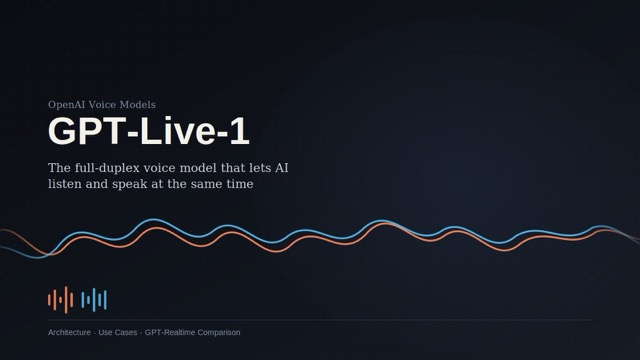
On July 8, 2026, OpenAI launched the GPT-Live family of voice models, making it the new engine behind ChatGPT's voice feature. This post breaks down what GPT-Live-1 actually is, its key advantages, where it fits in real-world use cases, and how it compares to other voice models on the market — including OpenAI's own Realtime lineup.
1. What Is GPT-Live-1?
GPT-Live-1 is OpenAI's purpose-built, full-duplex voice model, currently powering the Voice feature in the ChatGPT app and on the web. It comes in two tiers: GPT-Live-1 for paid users (Go/Plus/Pro), and GPT-Live-1 mini for free users. There are also Medium and High reasoning variants, which route to GPT-5.5's medium and high reasoning effort settings in the background.
One important clarification: GPT-Live-1 currently lives only inside the ChatGPT product — it's not yet available via API. Developers can only sign up to be notified when it launches. If you're a developer looking to build low-latency voice into your own app today, the option that's actually shipping is GPT-Realtime (the latest version being gpt-realtime-2.1) — a generally available, speech-to-speech API you connect to over WebSocket/WebRTC, with SIP support for phone integration and remote MCP server support for tool use. GPT-Live and GPT-Realtime are two parallel product lines with similar-sounding names but very different purposes — more on that comparison below.
2. Core Advantages: From "Walkie-Talkie" to "Real Conversation"
Genuine full-duplex architecture
Voice AI has gone through roughly two prior generations:
- Cascaded voice systems (the original ChatGPT Voice): speech-to-text → LLM generates a reply → text-to-speech, three models working in relay. Information could get lost between stages, and responses felt slow and stilted.
- Turn-based voice models (like ChatGPT's Advanced Voice Mode, built on GPT-4o): processing and generation happen in a single model, cutting latency — but interaction still happened in discrete turns. The model had to wait for you to stop talking, relying on silence detection to guess when your turn ended. A brief pause or background noise could easily be misread as "done speaking," causing awkward interruptions.
GPT-Live-1 instead processes audio continuously in both directions. It can tell you've started speaking while it's still talking, stop naturally, and keep the conversation coherent across the interruption. It can also wait patiently while you gather your thoughts instead of jumping in, and it throws in natural acknowledgments like "mhmm" or "got it" so you know it's actually listening.
A "keep talking while it works" delegation system
GPT-Live-1 itself is optimized for fluid, natural conversation — not deep reasoning. When a request needs web search, complex reasoning, or multi-step work, it delegates that task to GPT-5.5 running in the background, while continuing to keep the conversation flowing. Once the result comes back, it's woven naturally into the reply — you won't experience an awkward silent wait.
This "voice front-end + reasoning back-end" split means GPT-Live-1 can keep getting smarter as OpenAI upgrades the underlying frontier model, without needing to retrain the voice layer itself.
Stronger comprehension and noise resistance
In OpenAI's own evaluations, GPT-Live-1 significantly outperformed the previous Advanced Voice Mode on GPQA (expert-level scientific reasoning), BrowseComp (hard-to-find information via agentic web search), and an internal telecom-support benchmark simulating realistic, multi-turn customer service calls. It's also better at focusing on your voice amid background noise like traffic or nearby chatter.
Visual answers alongside voice
While talking, GPT-Live-1 can surface visual cards for things like weather, stock prices, sports scores, and maps — combining "hearing" and "seeing" in a way most pure voice assistants don't offer.
3. Typical Use Cases
- Everyday hands-free assistance: checking the weather, quick notes, language practice, bedtime stories, or casual chats during a commute — the bread-and-butter use case for ChatGPT Voice, now feeling much closer to talking with a real person.
- Real-time translation: the full-duplex architecture allows listening and translating simultaneously, reducing round-trip latency for cross-language conversations.
- Voice customer service / call-center scenarios: the delegation system lets the model stay warm and conversational while handing complex queries to a reasoning model in the background — something OpenAI's telecom-support benchmark results hint at (though this capability is currently confined to the ChatGPT product, not yet available to enterprises via API).
- Education and companionship: more natural turn-taking and patience with pauses make tutoring or speaking-practice scenarios feel smoother.
4. How It Compares to Other Models on the Market
| Dimension | GPT-Live-1 | GPT-Realtime (e.g. gpt-realtime-2.1) | Legacy Cascaded Voice Systems |
|---|---|---|---|
| Architecture | Full-duplex, continuous bidirectional audio processing | Speech-to-speech, single model, session-based interaction | STT + LLM + TTS relay |
| Handling complex tasks | Delegates to GPT-5.5 in the background; conversation never pauses | Depends on the model's own capability; supports function calling / tool use | Depends on the middle LLM stage |
| Availability | ChatGPT product only; API access "coming soon" | Publicly available API, pay-as-you-go, ready to integrate | Superseded by newer approaches |
| Target audience | Consumers using ChatGPT | Developers/enterprises building voice apps and voice agents | Historical approach |
| Signature features | Natural interruption handling, visual cards, vocal backchanneling | Function calling, MCP tool integration, SIP telephony support | Basic voice Q&A |
In short: if you just want more natural voice conversations with ChatGPT, GPT-Live-1 is what you're already using. If you're a developer building voice into your own product, GPT-Realtime is the option that's actually shipping today — despite the similar names causing enough confusion that several tech blogs have written explainers specifically to untangle the two.
5. Safety Design
Because voice interaction is more real-time and often more emotionally charged, OpenAI added dedicated safety training and red-teaming for GPT-Live-1 covering self-harm, psychosis/mania, emotional reliance on AI, violence, and sexual content. It also built in safeguards that can intervene mid-conversation — steering toward safer responses, surfacing crisis helpline resources, or ending the conversation in higher-risk situations. Parents can control whether teens can use ChatGPT Voice at all. The model is also restricted to a fixed set of preset voices, designed to prevent impersonation of real people.
6. Limitations
GPT-Live-1 still has some clear boundaries: it doesn't yet support voice during video calls or screen sharing (you'll need the legacy voice mode for that); support for less common languages is still being refined, with some languages showing accent or fluency gaps; and most importantly, there's no public API yet — developers can't build it into their own products for now.
Takeaway
GPT-Live-1 marks a shift from "take-turns Q&A" to genuinely real-time conversation, built around two ideas: a full-duplex architecture that feels natural, and a "voice front-end, reasoning back-end" division of labor. For now, it's aimed squarely at ChatGPT's end users rather than the developer ecosystem — if you're looking to bring similar capabilities into your own app, GPT-Realtime is the product line to watch.