What Can Jev Do? 8 Practical Use Cases for TypeSafe AI’s New Model
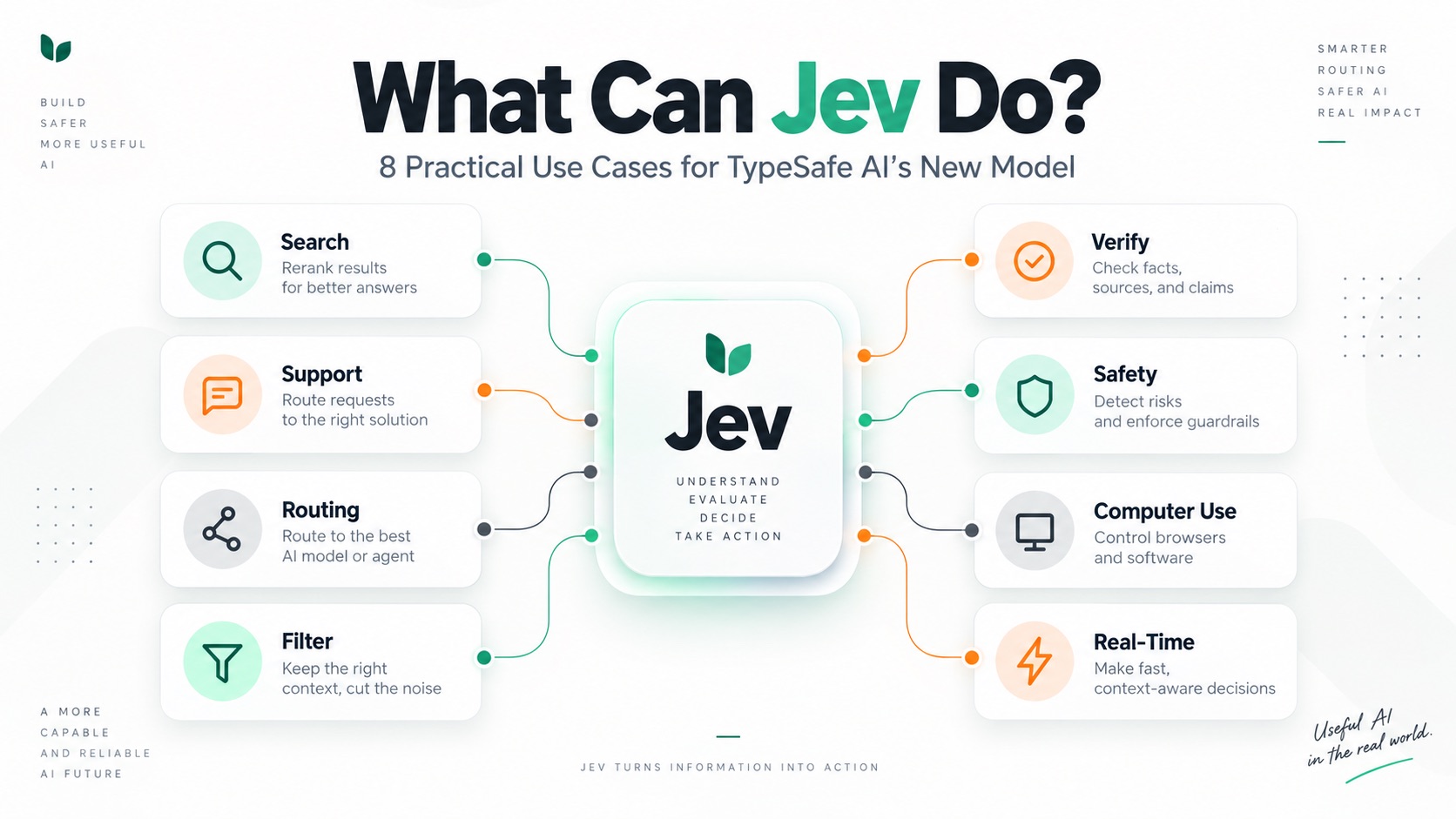
See how Jev can be used for search reranking, AI routing, context filtering, verification, safety checks, computer control, and other real-world decision tasks.
Most people are used to AI models that answer questions, write articles, generate code, or hold conversations. Jev takes a different approach.
Developed by TypeSafe AI, Jev is the company's first public System One Model. Instead of focusing on long-form text generation, it is designed to make fast, structured decisions that software can use directly.
That sounds abstract until you look at what developers are actually building with it.
Jev can help decide which search result deserves to rank higher, which team should receive a customer request, whether an AI agent should trust a piece of information, which action a computer-use system should take next, or even when a game character should jump.
The common thread is simple: Jev is useful when software does not need another paragraph. It needs a judgment.
Here are some of the most practical ways that idea can be used.
A Simple Way to Understand Jev
Imagine an online store receives this message:
“My order arrived, but I was charged twice. Can someone fix this?”
A traditional AI assistant might generate a polite response explaining what the customer should do.
Jev could instead help the system answer several smaller questions:
- Is this a billing issue?
- Does the customer appear to be requesting a refund?
- How urgent is the request?
- Should the case be handled automatically or sent to a person?
The application can then use those answers to decide what happens next.
This is why Jev fits naturally into software workflows. It sits between raw information and an action, helping code make decisions that are too fuzzy for simple rules.
1. Customer Support Triage
Customer support is one of the easiest Jev use cases to understand.
A company may receive thousands of messages every day covering refunds, login problems, technical bugs, subscription changes, delivery issues, and general questions. Someone or something needs to decide where each message belongs.
Traditional rule-based systems often depend on keywords. A rule might send every message containing “refund” to the billing team.
But users do not always use predictable wording.
One person might write:
“I want a refund.”
Another might say:
“Can I get my money back?”
A third might write:
“I don't think I should have been charged for this.”
All three can express similar intent without sharing the same keywords.
Jev can evaluate the meaning of the message and classify it into predefined categories such as billing, technical support, account access, or sales. The software can then route the request automatically.
The same workflow could also evaluate urgency or determine whether the case is clear enough to automate.
This makes Jev useful as a decision layer between an incoming message and the rest of a support system.
2. Search Result Reranking
Search engines are good at finding possible matches, but finding a result and deciding whether it is genuinely useful are not always the same thing.
Imagine a search system retrieves 50 pages for a query. Some are highly relevant. Others contain the right keywords but do not actually answer what the user wants.
Jev can be used after the initial search to judge those results again.
Instead of generating new content, it can evaluate questions such as:
How relevant is this result to the user's actual intent?
or:
Should this page appear above the other candidates?
The application can then reorder the results based on those judgments.
One public Jev experiment, Sift, applies this idea to Google search results by using Jev to rerank pages and reduce the prominence of results that appear to be sales-heavy or low-value.
This pattern is not limited to web search. The same approach could be used for internal company search, product search, document retrieval, knowledge bases, or AI retrieval systems.
In each case, Jev acts as a second-stage judge after the search engine has produced candidates.
3. Routing Tasks to the Right AI Model or Agent
Modern AI products increasingly use more than one model.
A single platform might have one model for coding, another for research, another for image generation, and several specialized tools for searching databases, reading files, or interacting with websites.
That creates a new problem:
Which model or tool should handle each request?
Using the most powerful model for everything can be unnecessarily expensive and slow. Hard-coded rules can also fail when users phrase requests in unexpected ways.
Jev can sit at the beginning of the workflow and classify the request.
For example:
- Coding task → coding agent
- Current information → web search
- Image request → image model
- Account issue → customer support workflow
- Unclear or sensitive case → human review
The task itself is then handled by the appropriate system.
This type of model routing is one of the most natural applications for a fast decision-focused model because the router does not need to solve the user's full request. It only needs to decide where the request should go.
4. Filtering Context Before It Reaches a Larger AI Model
AI agents often collect far more information than they eventually need.
A research agent might search dozens of pages. A coding agent might read large logs, documentation, and many files. A retrieval system might return hundreds of text chunks.
Passing all of that information into a large model creates several problems. It increases token usage, raises cost, and can distract the model with irrelevant information.
A decision layer can help filter that material first.
For every retrieved item, the system can ask questions such as:
Is this information relevant to the task?
Does this document contain evidence that helps answer the question?
Should this result be included in the final context?
Items that appear useful can continue to the next stage. Low-value material can be dropped or deprioritized.
This creates a pipeline like:
Retrieve information → Judge relevance → Keep useful context → Send to larger model
The larger model can then spend its resources on the information most likely to matter.
This type of filtering is particularly useful in retrieval-augmented generation, research agents, coding assistants, and systems that process large document collections.
5. Giving AI Agents a Verification Layer
AI agents are increasingly able to search the web, call tools, modify files, run code, and interact with external systems.
The more actions an agent can take, the more useful it becomes to have another layer asking whether those actions or inputs should be trusted.
One public project, Jev MCP, exposes Jev as a set of tools that AI agents can use for tasks such as checking claims against evidence, screening content before it enters context, and ranking candidates by meaning.
Consider a research agent that finds a statement on a webpage.
Instead of immediately using the claim, the workflow could ask:
Does the supplied evidence actually support this statement?
Or imagine an agent collects ten possible sources. Jev can help estimate which candidates are worth examining first.
This does not make an agent automatically correct. A structured model can still make the wrong judgment.
The benefit is that verification becomes a separate, explicit step rather than something developers simply hope the main model performs reliably.
6. Safety Checks Before an AI Agent Acts
Verification can also be applied to actions.
Imagine an autonomous agent that can delete files, send messages, change settings, or submit information to a website. Some actions are harmless, while others deserve more scrutiny.
A system can place a decision layer before potentially important actions and ask questions such as:
Is this action consistent with the user's goal?
Does this look unusually risky?
Is this action reversible?
Should a human confirm before the agent continues?
If the model has high confidence that an action is routine, the workflow can proceed. If the situation looks uncertain, the software can require another check or human approval.
This is an important distinction between AI judgment and AI control.
Jev can provide the judgment, while normal application code still decides what is allowed to happen.
That means developers can use AI for fuzzy decisions without handing the model unrestricted authority over the system.
7. Faster Computer and Browser Control
Computer-use agents often rely on large multimodal models that repeatedly inspect screenshots, reason about the screen, and decide what to click next.
That can work, but many individual steps are much simpler than they appear.
If a system already knows which buttons, links, or controls are available, the next action may just be a choice from a short list.
A public project called TypeSafe Computer Use explores this approach on macOS. It reads the screen using deterministic methods, converts what it finds into structured information, and uses Jev to choose the next bounded action. A separate text-generating model is only needed when free-form writing is actually required.
The broader idea is useful beyond that specific project.
Instead of asking a large model to rethink the entire task after every click, computer-use systems can separate the workflow into different jobs:
- Perception identifies what is on the screen.
- Jev chooses among available actions.
- Deterministic software performs the action.
- A generative model is called only when open-ended language or deeper reasoning is required.
That division could make certain browser and desktop automation workflows faster and more economical.
8. Real-Time Decisions in Games and Interactive Systems
Some of the most unusual Jev demonstrations involve games.
At first, using an AI decision model to play Mario or Minecraft may sound unrelated to business automation. But games provide a useful way to test one of Jev's key ideas: making repeated decisions quickly from changing state.
The public TypeSafe Mario project, for example, converts emulator information into structured data describing Mario's movement, nearby enemies, terrain, jump state, and other conditions.
Jev then selects from a limited set of legal actions such as moving right, jumping, running, or doing nothing.
The important part is not Mario itself.
The pattern looks like this:
Observe current state → Choose an action → Execute → Observe again
That same structure appears in robotics, browser agents, interactive applications, autonomous tools, and other systems that need frequent low-latency decisions.
Games simply make the concept easy to see.
What These Jev Use Cases Have in Common
Customer support, search ranking, AI agents, computer control, and games may seem like completely different applications.
But from Jev's perspective, many of them have the same basic structure.
The software has some information about the current situation. It needs a small number of judgments. Those judgments influence what the program does next.
In customer support, the question might be:
Which department should receive this request?
In search:
Which result is most relevant?
For an agent:
Is this evidence trustworthy enough to use?
For computer control:
Which action should happen next?
For a game:
Should the character jump now?
The surrounding software is different, but the model's role remains similar.
It is acting as a decision layer.
Where Jev Fits Beside Traditional LLMs
Jev is easier to understand when it is not treated as a replacement for models such as GPT or Claude.
Traditional language models are extremely useful when a task requires generation. They can explain, summarize, write, brainstorm, code, and communicate with people.
Jev focuses on a narrower job.
A useful AI workflow might therefore use both.
Consider customer service again. Jev could determine the intent, urgency, and routing of a request. A generative model could then write the actual response.
In a research agent, Jev might filter and rank sources while a larger model reads the strongest evidence and writes the final report.
In computer use, Jev might choose routine actions while a larger model handles difficult planning or text generation.
Instead of asking one AI model to do everything, applications can divide the work according to what each model is good at.
What Jev Does Not Solve
Structured decisions do not automatically make an AI system reliable.
Jev still has to interpret information, and those interpretations can be wrong. Choosing from a predefined set guarantees that the answer fits the expected structure; it does not guarantee that the selected answer is always correct.
Developers also need to define good questions and useful options.
If a support system only provides the categories sales and technical, but a customer is clearly asking for a refund, even a strong model is being forced into a poorly designed choice.
The same problem appears with vague scoring criteria, missing context, or badly chosen automation thresholds.
That is why the most practical Jev workflows keep important policy and control logic in regular code. The model handles the ambiguous judgment, while the application determines what actions are permitted.
Jev is also still new. TypeSafe released it in early access in September 2026, and many current projects are experiments or early community implementations rather than long-established production systems.
The current use cases are best viewed as examples of where the model's design may be useful, not proof that every application should adopt the same architecture.
From AI That Talks to AI That Decides
Generative AI has made it natural to think of intelligence as something that answers us in words.
Jev highlights another possibility.
Some of the most frequent AI tasks inside software may never need to produce language at all.
A program may only need to know whether something is relevant, which category it belongs to, which route to take, how risky an action appears, or whether another system should be called next.
Those judgments are small individually, but modern applications can make them thousands or millions of times.
That is where Jev's approach becomes interesting.
It is not trying to replace the AI that writes the answer. It is designed for the countless decisions that happen before, after, and between those answers.