MiniMax H3 Deep Dive: The Ultimate Showdown vs. LTX 2.3 and Seedance 2.0 on Pixomi
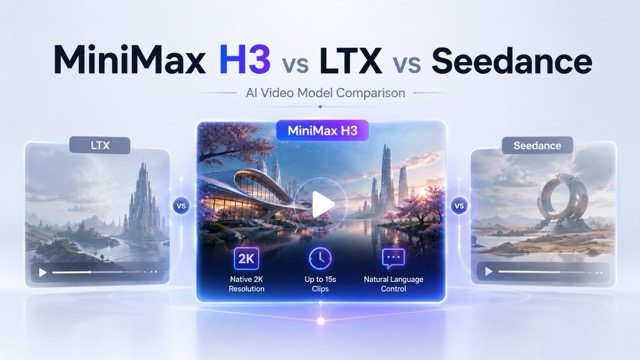
This guide analyzes the newly released MiniMax H3 and compares its performance against two popular benchmarks: LTX 2.3 (an open-weights staple) and Seedance 2.0 (a leading visual standard). Read on to learn about their core features, performance trade-offs, and ideal use cases.
MiniMax H3 is the latest addition to the open-weights AI video ecosystem, designed to address key limitations in video generation—specifically resolution and clip duration. Key features of MiniMax H3 include:
- Native 2K Resolution: High-definition video output without requiring upscaling steps.
- Extended Duration: Generates coherent video clips up to 15 seconds in a single pass.
- Direct Natural Language Control: Edit and refine video elements directly through text prompts.
Available on Pixomi: MiniMax H3 is fully integrated into Pixomi. You can run and test the model immediately in your browser without local hardware setup or high VRAM requirements.
Browse Minimax H3 Prompt Examples
MiniMax H3 vs. LTX 2.3: The Productivity Battle
When it comes to the open-weights ecosystem, LTX 2.3 has long been the reigning champion of granular control. However, MiniMax H3 introduces a radically different approach to workflow efficiency.
-
Ease of Use vs. Micro-Control: LTX 2.3 thrives in complex, node-based environments like ComfyUI, giving technical users absolute authority over depth maps and edge detection. MiniMax H3, on the other hand, excels in natural language understanding, allowing users to tweak and modify video elements simply by talking to it.
-
Generation Specs: MiniMax H3 pushes the boundaries with native 2K resolution and the ability to generate up to 15 seconds of coherent video in a single pass, whereas LTX 2.3 typically requires more careful handling to avoid background drift in longer clips.
-
The Pixomi Advantage: Setting up LTX 2.3 locally requires serious GPU horsepower and complex installations. By using Pixomi, you get instant, cloud-based access to MiniMax H3. No terminal commands, no VRAM limits—just pure creative output.
MiniMax H3 vs. Seedance 2.0: Reaching for the Visual Ceiling
If the LTX 2.3 comparison is about workflow, the battle against Seedance 2.0 is purely about pushing the absolute visual ceiling. Seedance 2.0 remains the gold standard for cinematic quality, but MiniMax H3 is proving to be a formidable challenger.
-
Identity Lock and Consistency: Seedance 2.0 is famous for its flawless character consistency across complex camera movements. MiniMax H3 holds its ground surprisingly well, maintaining facial features and clothing details impressively over its 15-second generation window.
-
Physics and Motion: Both models showcase a deep understanding of physical laws. While Seedance 2.0 might edge out slightly in ultra-complex fluid dynamics or lighting reflections, MiniMax H3 delivers incredibly stable 24FPS motion that feels natural and cinematic.
-
Head-to-Head Testing: The beauty of Pixomi is that we host both MiniMax H3 and Seedance 2.0. You don't have to take our word for it—you can run the exact same prompt through both engines in your Pixomi workspace to see which aesthetic fits your project best.
Which Model is Right for You? (And Exploring Pixomi's Arsenal)
Choosing your "daily driver" depends entirely on your project's needs:
- Choose MiniMax H3 if you want fast, high-resolution, long-form generations with intuitive text-based control.
- Choose LTX 2.3 if you are a technical artist who needs precise, video-to-video motion transfer and node-based workflows.
- Choose Seedance 2.0 if your project demands the absolute highest tier of cinematic realism and strict character consistency.
Pixomi is an all-in-one AI creation hub designed to eliminate technical barriers. Alongside MiniMax H3 and Seedance 2.0, our platform gives you instant access to a massive library of cutting-edge models, including PixVerse V6 for stylized animations, Seedance 2.0 Fast for rapid prototyping, and Seedance 2.0 Mini for quick, lightweight tasks.
If you want to explore the bleeding edge of AI video without buying a $3,000 graphics card, Pixomi is your ultimate playground.
Pro Prompt Guide for AI Video Generation
To get the best results out of MiniMax H3 and Pixomi's other models, your prompts need structure.
A winning formula generally follows this order:
[Subject/Character] + [Specific Action] + [Camera Movement/Angle] + [Lighting/Atmosphere] + [Resolution/Format].
Example 1: Cinematic Action
A highly detailed cyberpunk street samurai wearing a glowing neon mask, drawing a katana in the pouring rain. The camera executes a slow Dolly-in, tracking the character's movement. Cinematic lighting, volumetric fog, neon reflections on wet asphalt, 4k resolution, hyper-realistic.
⬆️Video generated by Seedance 2.0 in Pixomi
Example 2: Macro Nature
Extreme close-up of a single water droplet falling onto a vibrant green fern leaf in a dense rainforest. The camera pans smoothly to the right as the droplet shatters into smaller beads. Soft, diffused morning sunlight, shallow depth of field, photorealistic, 24fps.
⬆️Video generated by MiniMax H3 in Pixomi
The Final Cut: Your Next Steps in AI Video
The arrival of MiniMax H3 has undeniably reshuffled the deck in the open-weights AI video ecosystem.
While LTX 2.3 remains a fantastic tool for creators who need granular, node-based control, and Seedance 2.0 holds onto its crown for top-tier cinematic consistency, MiniMax H3 strikes an incredible balance. It offers stunning 2K resolution, 15-second generation times, and an incredibly low barrier to entry thanks to natural language prompting.
The best AI video model isn't just about specs on paper—it's about how it fits into your specific creative vision. That is exactly why Pixomi AI video generation tool is built to be your all-in-one AI canvas.
You don't need to choose just one model, and you certainly don't need to spend hours configuring local environments or buying expensive hardware.
Stop reading about the future of video generation and start directing it. Head over to your Pixomi workspace and bring your first prompt to life today!